Many countries with abundant natural resources experience lower economic growth than countries with little or no natural resources. In the economics literature this is referred to as the "resource curse". One reason put forward is lack of technological progress. In a recent study, we have examined a related issue, that is, whether a resource curse may occur due to the wrong type of technological progress, write Greaker, Heggedal and Rosendahl.

News from TIK - Page 3
Many countries with abundant natural resources experience lower economic growth than countries with little or no natural resources. In the economics literature this is referred to as the "resource curse". One reason put forward is lack of technological progress. In a recent study, we have examined a related issue, that is, whether a resource curse may occur due to the wrong type of technological progress.
Earlier this year, Osiris had the pleasure to welcome postdoctor Knut Jørgen Vie to the team.
Lars Wenaas is the first Osiris Ph.D. candidate to submit his doctoral thesis. The thesis looks at the effects of open access. The public defense will take place at the University of Oslo on 11th November 2022.
Frauke Rohden, Ph.D. candidate at TIK and part of the OSIRIS team, is in the final stages of her Ph.D. work. In her thesis she looks at the role of informal science-oriented online activities for the diffusion, understanding, and use of scientific knowledge. We decided to ask Frauke some questions about her project.
How does science make its way from academic research into society? There is agreement that the connection between science and society is not a linear or simple process. This blog post presents six perspectives on the complexity, long timespans and many different actors involved in scientific impact processes.
From June 1-3 2022, the Osiris team attended the yearly Eu-SPRI conference. This year’s theme was “Challenging Science and Innovation Policy” and the aim was to explore future directions for studies of Policies for Research and Innovation with a special emphasis on the topics of Digitization, Open Science and Futuring.
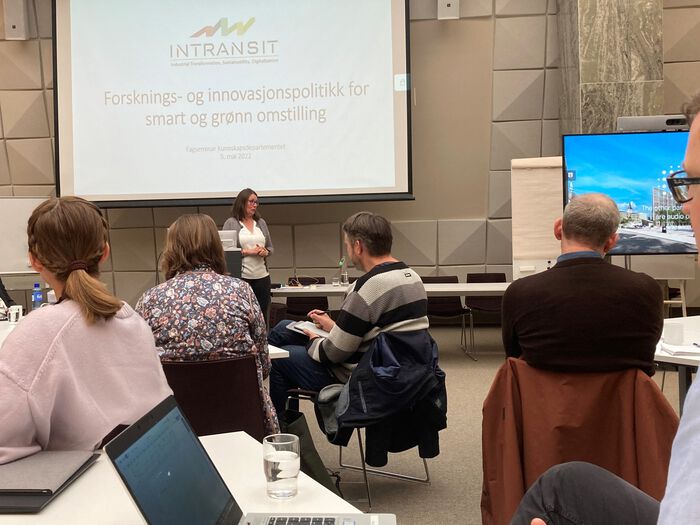
A challenge in transitions is how to efficiently link research with policymakers' current issues, problems, and questions. With that in mind, INTRANSIT, the Norwegian Research Council, and the Ministry of Education and Research hosted a seminar for informal discussions between researchers and bureaucrats from different ministries.
After more than two years of zoom meetings, the Osiris consortium finally met physically again for a two-day meeting in Valencia, Spain. The meeting was hosted by Osiris partner INGENIO and took place at their offices at Ciudad Politécnica de la Innovación.
How does science make its way from academic research into society? There is agreement that the connection between science and society is not a linear or simple process. This blog post presents six perspectives on the complexity, long timespans and many different actors involved in scientific impact processes.
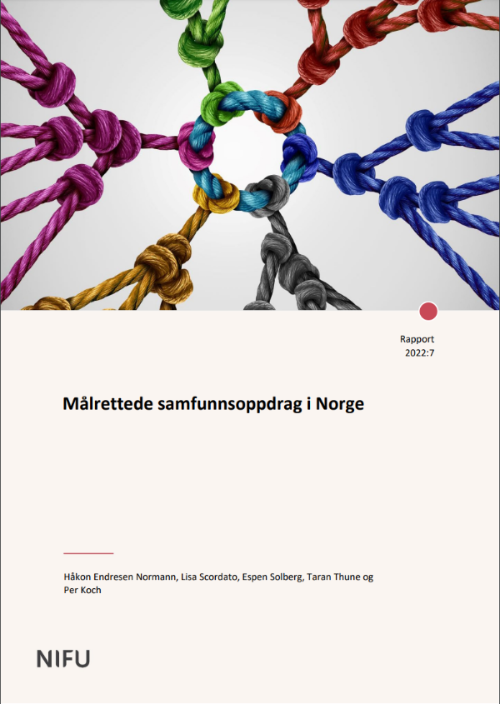
Centre director, Taran Thune, has contributed to a new report on how missions can be used for tackling grand societal challenges in Norway.
Osiris is happy to welcome two new members to the team: Mayra Morales Tirado from University of Manchester and Gemma Derrick from University of Bristol.
Processing grant applications and assigning them to an appropriate group of experts for evaluation, is one of the challenges of the Research Council of Norway (RCN). At a recent OSIRIS meeting, representatives of the RCN gave insights into their use of artificial intelligence (AI) as a tool for optimizing case handling.
On September 1st, 11 Oslo-based OSIRIS researchers gathered in Fredrikstad for the first physical workshop in almost 1,5 years.
Despite the challenges of the pandemic, there has been a great deal of activity in OSIRIS during the past year.
In June 2021, OSIRIS co-organised the annual Eu-SPRI conference. The digital format attracted a record number of more than 400 participants for the three-day online event.
OSIRIS researcher Gry Høiland is studying how research is used in the Norwegian Labor and Welfare Administration (NAV).
The Eu-SPRI 2021 conference invites participants to a more critical and reflexive discussion of the linkage between science and innovation.
OSIRIS is happy to offer a three-year postdoctoral position to carry out longitudinal case studies of how research gets used.
We are happy to announce that the Research Council of Norway (RCN) has decided to fund the OSIRIS Centre for the last period of the centre. An international panel of experts has evaluated the centre and recommended that it continues. This recommendation was adopted by the RCN's board of directors in February this year.
The Little Tools project was recently featured in the European Commission's 'Results Pack on frontier research for the Green New Deal'.
From the 9th to 11th of December 2020, the OSIRIS team participated at the Workshop on Medical Innovation (WOMI), which was organised by Maynooth University School of Business and Gothenburg Center for Knowledge-intensive Innovative Ecosystems.
TIK's ERC Starting Grant project welcomes two new research assistants, Minja Mitrovic and Jonas Engestøl Wettre, to the group.
In their new blog post, OSIRIS researchers Magnus Gulbrandsen, Erlend Simensen and Taran Thune present a large survey among users of research in public agencies.
Is there a contradiction between quality and relevance? Do researchers emphasize originality and publication in prestigious journals, while users want easy-to-read and simple answers to practical questions? A new, large survey among users of research in public agencies indicates that users emphasize many of the same quality criteria as the researchers themselves.