

About the project
Why has our society been unsuccessful in addressing deforestation, climate change, and other environmental problems? After all, we have been able to deal with many other challenges, and we have today better technologies and economic means than any time before.
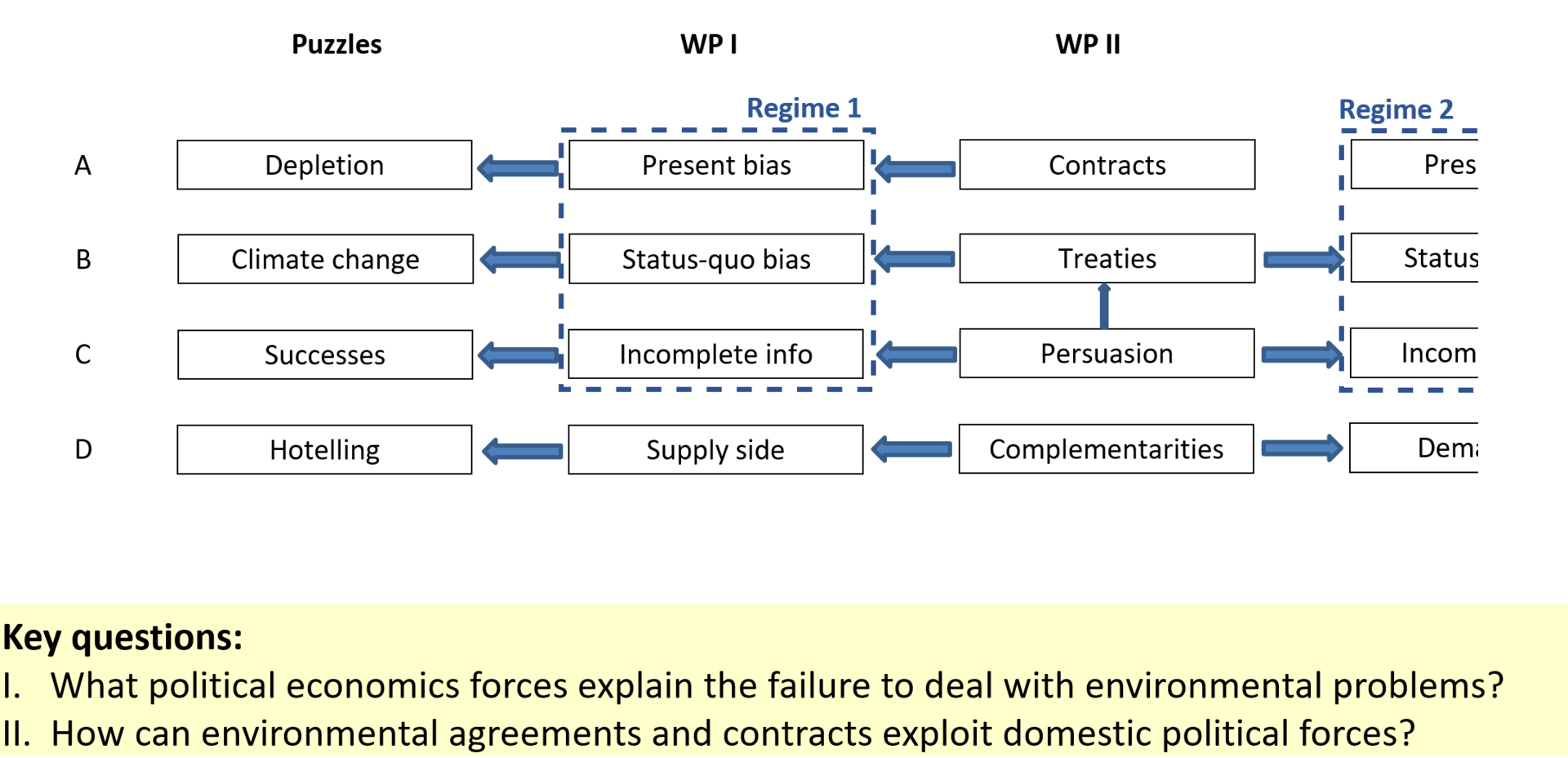
In this project, we seek to shed light on two questions:
- What political economics forces explain the failure to deal with environmental problems?
- How can environmental agreements and contracts exploit domestic political forces?
The first, positive, part seeks to develop dynamic political economics models that can be combined with models of climate change and other environmental problems. The goal is to learn more about what political economics forces or constraints are best able to explain the observed inefficiencies in environmental policies. This knowledge is necessary before we can analyse which policies are best - subject to the relevant constraints.
The second, normative, part is more groundbreaking because it investigates how international environmental policies can exploit the political forces that are important at the domestic level.
Intuitively, when desirable policies are hindered by political forces, such as present bias and time inconsistency, an incumbent may value a treaty that offers pre-commitments or credibility. This value implies that the incumbent can be persuaded to contribute more (to emission cuts, for example) if the agreement is designed so that it helps the incumbent overcome domestic political constraints. By drawing on contract theory and organizational economics, we will investigate how international policies can exploit time-inconsistent incumbents' demands for commitment, how status-quo biases offer credibility, and how inattention permits persuasion.
The project will contribute methodologically to political economics and contract theory.
Principal investigator
Bård Harstad is a professor in political economy, and of business and sustainability, at Stanford GSB. He is also affiliated with the University of Oslo, and this is the third ERC grants that he is leading.
For more on his research, please consult with his homepage at Stanford.