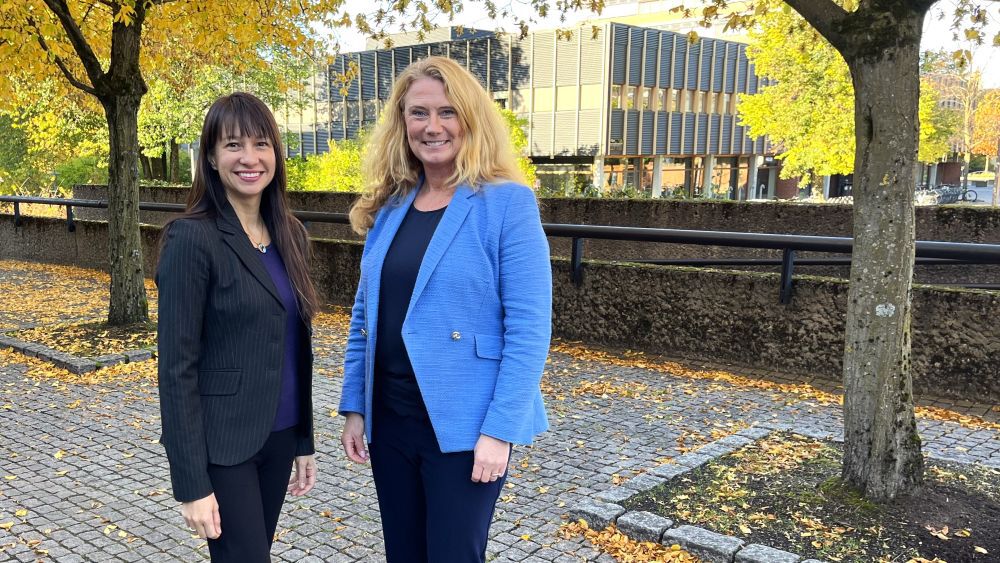
“It is not sufficient to think about the 10- to 20-year timeframe. We need to think much more on the 50- to 100-year timeframe,” says Mai’a Cross.
Mai’a Cross is Dean’s Professor of Political Science, International Affairs, and Diplomacy and Director of the Center for International Affairs & World Cultures at Northeastern University, and guest in the latest episode of Arena Europa.
In her forthcoming book ‘The European Union’s Grand Strategy: A Planetary Approach for Safeguarding the Future', Cross argues that Europe has a grand strategy that is planetary in scope.
Cross explains that the planetary focus expands the level of analysis from just decades to generations or civilisation levels.
“A planetary grand strategy incorporates a more existential focus,” she says.
Listen to the full episode in Spotify, Apple Podcasts or here:
The EU planning for the next century
“The very idea that the EU has a grand strategy might surprise some listeners,” says Pernille Rieker, Centre Director of ARENA Centre for European Studies and host of Arena Europa.
“It is a term that we usually associate with powerful states like the US or China,” she continues.
“In this book, I wanted to point out that the EU actually does have a grand strategy. It is just a different type of grand strategy,” says Cross.
She explains that the EU differs partly because it lacks the same power resources as the US and China
“Where the EU's real strength is, I think, is how it is planning for the next century and the infrastructure it has put in place over the last seven decades that will matter to humanity's future.”
“I wanted to focus on that because we get so bogged down in traditional power metrics that we might miss the EU's influence on a planetary level,” says Cross.
About Arena Europa
Arena Europa is a podcast series by ARENA Centre for European Studies at the University of Oslo. We invite experts to help us make sense of key European issues.
Find all episodes here, in Spotify or in Apple Podcasts.
Read also:
Year 2050 as a turning point
In her book, Cross highlights the year 2050 as a turning point for climate, artificial intelligence, and human security.
“If you imagine that your planetary vision succeeds, what would the world look like in 2050?” asks Rieker.
“From a planetary perspective, 2050 is not that far in the future,” says Cross.
She cites experts who see 2050 as a potential tipping point. By that year, we need to reach net zero climate emissions. In addition, the population over the age of 65 will triple compared to today, which creates a huge demographic strain. And on the technological front, some anticipate that AI might reach the so-called singularity where it surpasses human intelligence and then starts to self-improve, Cross explains.
“I think if the planetary grand strategy of the EU continues, and others start to act on this in similar ways, 2050 will pass with a little less of a sense of potential doom.”