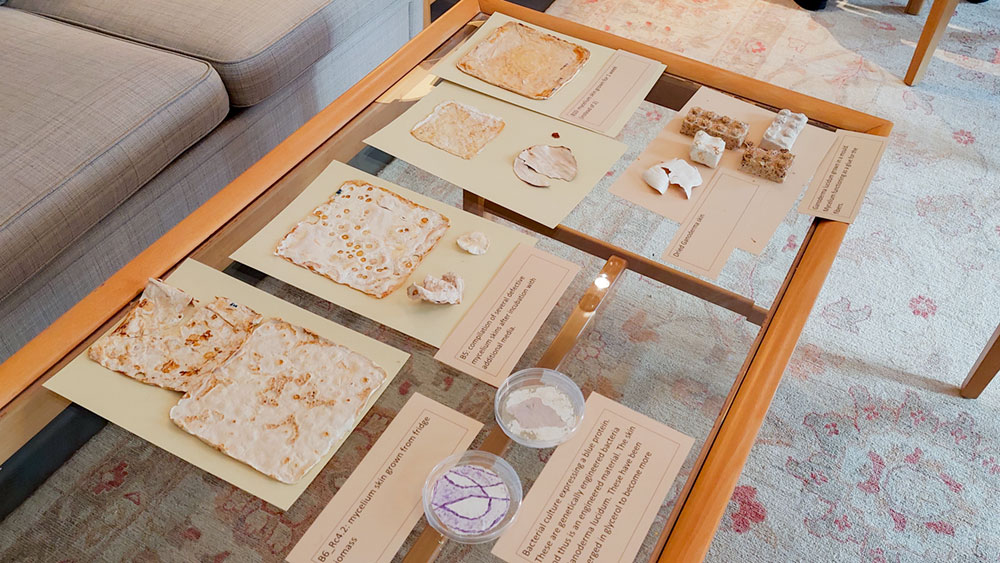

Imagine a world in which walls and everyday life things surrounding you are living. Engineered Living Materials (ELMs) are envisioned as enabling a wide range of solutions towards a transition to greener economies. The FUNGATERIA consortium explores collaborations between fungi and bacteria, developing models and prototypes to produce materials with computational capabilities. Mycelium based living materials such as those being developed in FUNGATERIA open for new ways of imaging buildings and cities, and potentially many other objects. ELMs are qualified as being ‘smart materials’ in that they take advantage from intrinsic properties of life such as the capacity for self-repairing and healing. This creates opportunities and challenges with regards to designing such materials to behave in a controlled way over time. Anticipating futures through activities such as modeling is key to design activities in FUNGATERIA.
FUNGATERIA is organized in seven teams collaborating across European universities. The team based at the University of Oslo coordinates WP7 - ELM Futures. WP-7 develops a citizen science methodology to explore public issues, sensibilities and future projections of living materials, particularly ELMs.
The FUNGATERIA consortium is led by the Danish Royal Academy for Architecture, Design and Conservation, in partnership with The Free University of Brussels, The Democritus University of Thrace, The University of Ghent, University of Utrecht, University of the West of England, Bristol and the University of Oslo. The project builds on interdisciplinary collaborations, and all partners are involved in communication, public engagement and dissemination activities.*
Read more: fungateria.eu