“Bureaucrats have expertise that politicians do not have. They should be impartial and experts in how to implement laws in a correct way,” says Alicia Saes-Louarn.
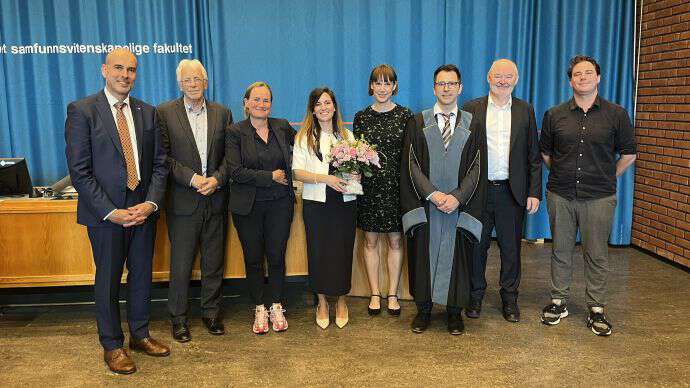
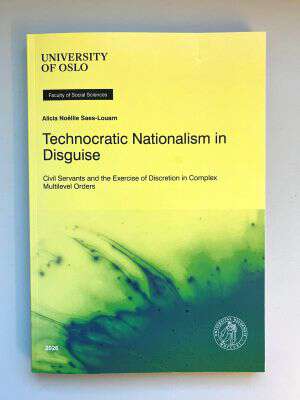
She was a PhD Fellow at ARENA Centre for European Studies and defended her dissertation ‘Technocratic Nationalism in Disguise: Civil Servants and the Exercise of Discretion in Complex Multilevel Orders’ on 11 June.
Can adapt laws to the Norwegian system
In her thesis, Saes-Louarn has studied how Norwegian civil servants interpret, implement and apply EU law within the Norwegian administrative system. As part of the European Economic Area (EEA) agreement, Norway should apply all EU law that has been judged EEA relevant. Specifically, Saes-Louarn has studied how civil servants legitimise or justify why they implement laws in the way they do.

“They can have significant interpretative leeway, but the EEA system is intended to preserve legal homogeneity, so shared laws should be interpreted and applied consistently across the EEA.”, says Saes-Louarn.
Leeway means that Norway does not always have to implement EU rules in exactly the same way as another country, she explains.
“There is often some room to adapt laws to the Norwegian context, as long as the final result still complies with EEA law,” says Saes-Louarn.
This is the case for directives from the EU. They set a binding goal that EU and EEA countries must achieve while normally leaving the national authorities some choice over how they want to implement them. So Norwegian officials can adapt the laws to the national setting.
A directive is different from a regulation which is directly applicable to EU member states and ultimately applicable to Norway once it becomes part of the EEA agreement and incorporated into Norwegian law, explains Saes-Louarn.
How civil servants legitimise their decisions
In her PhD thesis, Saes-Louarn develops the concept of “technocratic nationalism”. It describes a logic of justification in which civil servants combine professional expertise with appeals to the Norwegian interest, national responsibility and sovereignty.
Civil servants in this logic present an interpretation of the law which is nationally oriented and at the same time portray the decision as both technically and legally defensible.
“The issue is that, in the settings I studied, some officials justified their choices by presenting them as serving what is ‘best’ for the Norwegian public interest,” says Saes-Louarn.
“But decisions about what is in Norway’s interest is not a bureaucratic question, it is a political one. When officials are determining what counts as the national interest, their role can get a representative or quasi political. This is raising serious questions about transparency and democratic accountability,” she continues.
This type of reasoning appears among the civil servants in the administrative settings Saes-Louarn studied, especially when civil servants have quite a lot of discretion in interpreting and applying EEA law.
Interviews with highly ranked civil servants
Saes-Louarn has used surveys, document analysis and in-depth interviews in her thesis.
“I have done a limited number of interviews with highly ranked civil servants who were directly involved in important decision-making processes.”
She highlights that the strength of the interviews is not in the large number, but that they gave her access to how discretion and leeway are understood and justified at levels of the administration where these decisions are actually made.
Saes-Louarn’s survey data confirms that the pattern is not limited to just a few individual officials.
“But I cannot generalise from my data and say that it applies equally to all civil servants, ministries or agencies.”
Not elected by the people
“Is it that problematic that they claim to act in Norway’s interest?”
“To consider national circumstances in itself is not what is very problematic,” says Saes-Louarn.
She thinks what is problematic is when important political choices about what is the national interest are made through administrative discretion without sufficient transparency, political authorisation or even accountability.
“Civil servants are not elected by the people, unlike politicians,” she adds.
“Bureaucrats have an expertise in their field, but determining how the public interest should be balanced is ultimately a political question.”
Saes-Louarn explains that civil servants sometimes make decisions that go beyond a simple interpretation of the law.
“We have a democratic system where we vote for the people we want to represent us.”
Read about the project European integration and national law: Compliance in complex institutional orders (COMPLEX).
Compensating for limited democratic influence
Norway is obligated to implement relevant EU laws, but are not represented in the EU institutions that make these laws. That is often described as a democratic problem for Norway.
“The EEA agreement creates a particular structural situation where Norway has to implement a large amount of EU legislation without having full political representation when those rules are made,” says Saes-Louarn.
In her interview data, Saes-Louarn finds that some civil servants are very conscious of this situation. She also finds that they justify the use of their discretion to find what they see as the best solutions for Norway.
“My interpretation is that technocratic nationalism can partly be understood as a response to this democratic asymmetry,” she says.
Some of the questions of representation and national interest that would normally be dealt with politically when legislation is made are - in the EEA context - pushed towards the implementation stage. Civil servants can then end up taking a role a politician would normally have when they exercise their discretion.
“They seem to rely on their expertise and administrative discretion, in part, to compensate for a system in which Norway has limited democratic influence at the EU level,” says Saes-Louarn.
Could you find it in other countries?
Saes-Louarn wonders if technocratic nationalism is something happening only in Norway, because of this paradox: that Norway implements EU laws without full representation or direct voting rights.
“I think this tendency may be visible in other countries too. Although Norway’s relationship to the EU is quite unique, civil servants in EU member countries also have discretion, and may face similar tensions between applying EU law and protecting national interest.”
“If I could conduct an unlimited amount of interviews, I would study if technocratic nationalism occurs also in full EU member states and how full formal participation in EU decision making affects this justificatory pattern,” says Saes-Louarn.