HISTCLASS Paradoxes of wealth and class: historical conditions and contemporary configurations

Status
Completed
Duration
01.01.2018–31.12.2024

The Norwegian or Nordic «model» is characterized by generous universal welfare provision and small wage inequalities. These egalitarian features do not imply that there is an equal distribution of wealth in the Scandinavian countries, or that the rich do not accumulate large fortunes.

Contact

collage of buildings in oslo; viktoria terrasse, UiO, Rådhuset and Børsen
Why is wealth inequality so pronounced in a society that in many respects is comparatively egalitarian? Photoillustration: Colorbox/UiO

About the project

Previous research indicates that the distribution of wealth is much more unequal in Scandinavia than in other European societies. Moreover the proportion of millionaires is high in Norway, and young Norwegian heirs stand out as especially wealthy in a global perspective. These paradoxical features are the point of departure for the project HISTCLASS. The project raises questions such as: Why is wealth inequality so pronounced in a society that in many respects is comparatively egalitarian? How should one explain such paradoxical features, and what do they mean for the understanding of Scandinavian egalitarianism? Are these paradoxes relatively new, or do today's rich families maintain family dynasties that have persisted over generations?  Are dynastic tendencies also found in families with top-level positions in other sectors, such as in the cultural sector, the professions, among civil servants, and in the academic world? To what extent does marriage between people from similar social milieus contribute to accumulation of resources over time?

These questions are addressed on the basis of a combination of historical and more recent datasets. We use data from older censuses and other historical sources, newer administrative population data, as well as a number of data sources on prominent people in various sectors. The Oslo Register Data Class Scheme (ORDC) serves as a point for departure for studying class inequalities. The analyses will detail the level of persistence and change of the stratification structure during the last two hundred years, with a special focus on accumulation of wealth, transmission of wealth over generations, and the production and reproduction of family dynasties at the top of society.

Objectives

Primary objectives

To produce unique sociological evidence on the development of Norwegian structures of stratification through two hundred years, with particular attention to the role of wealth accumulation and processes of intergenerational transmission

Secondary objectives

To provide knowledge about

1) the changing structure of stratification in Norwegian society over a long period;

2) the accumulation of wealth and its intergenerational impact during the  last three decades;

3) change and stability in the recruitment to Norwegian elites through the last three hundred years; and

4) the changing permeability of class boundaries through examining class endogamy and educational homogamy.
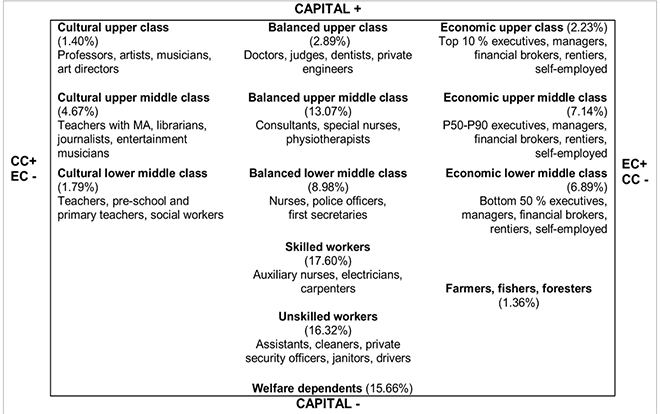
table
*Examples of occupations and proportions within each category, based on the distribution of the classes are provided in the figure.  

Participants

Publications

  • Schnitzlein, Daniel D.; Lersch, Philipp M. & Wiborg, Øyvind Nicolay (2026). Intragenerational mobility in wealth in Germany, Norway, and Britain: Descriptive evidence. Research in Social Stratification and Mobility. ISSN 0276-5624. 106. doi: 10.1016/j.rssm.2026.101206. Full text in Research Archive
  • Thomsen, Jens-Peter; Andrade, Stefan Bastholm; Hertel, Florian R.; Thaning, Max & Wiborg, Øyvind Nicolay (2026). Intergenerational Educational Mobility in Scandinavia and the United States. Sociology of education. ISSN 0038-0407. doi: 10.1177/00380407261424502. Full text in Research Archive
  • Wiborg, Øyvind Nicolay & Gugushvili, Alexi (2025). Does partnership predict mortality? Evidence from a twin fixed effects study design. SSM - Population Health. ISSN 2352-8273. 30. doi: 10.1016/j.ssmph.2025.101805. Full text in Research Archive
  • Gugushvili, Alexi & Wiborg, Øyvind Nicolay (2025). Wealth and mortality among late-middle-aged individuals in Norway: a nationwide register-based retrospective study. The Lancet Regional Health - Europe. 48. doi: 10.1016/j.lanepe.2024.101113. Full text in Research Archive
  • Strømme, Thea Bertnes & Wiborg, Øyvind Nicolay (2024). Social origins and educational attainment: The unique contributions of parental education, class, and financial resources over time. British Journal of Sociology. ISSN 0007-1315. 75(4), p. 400–419. doi: 10.1111/1468-4446.13091. Full text in Research Archive
  • Grätz, Michael & Wiborg, Øyvind Nicolay (2024). Parental ages and the intergenerational transmission of education: evidence from Germany, Norway, and the United States. European Societies. ISSN 1461-6696. 26(5), p. 1444–1471. doi: 10.1080/14616696.2024.2310011. Full text in Research Archive
  • Toft, Maren (2023). Nation-builders and market architects: How social origins mold the careers of law graduates over 200 years in Norway. British Journal of Sociology. ISSN 0007-1315. 75(1), p. 108–131. doi: 10.1111/1468-4446.13066. Full text in Research Archive
  • Schulz, Jeremy; Wiborg, Øyvind & Robinson, Laura (2023). Zooming Versus Slacking: Videoconferencing, Instant Messaging, and Work-from-Home Intentions in the Early Pandemic. American Behavioral Scientist. ISSN 0002-7642. doi: 10.1177/00027642231155364. Full text in Research Archive
  • Hansen, Marianne Nordli (2023). Økonomiske eliter og økonomisk makt. Norsk sosiologisk tidsskrift. 7(4-5), p. 92–109. doi: 10.18261/nost.7.4-5.7. Full text in Research Archive

View all works in NVA

View all works in NVA

Funding

Funded by The Research Council of Norway

Project number: 275249

The total grant award was for NOK 9 697 000.

Independent Projects - FRIPRO.

Norwegian version of this page
Published Aug. 18, 2025 2:51 PM - Last modified Jan. 9, 2026 9:16 AM