“You need to cultivate the mind and the body! Today was a back day in the gym, followed by a classical literature raid.”
– Direct quote from a Norwegian channel associated with the Active Club network.
In 2022 and 2023, several Norwegian and Swedish Telegram channels related to the international far-right Active Club Network began to appear. This development of separate, but interconnected, online groups is part of a recent trend in digital far-right organizational structure in Scandinavia. Channels made by individuals within the Active Club milieu have also become popular, the most noticeable being a Swedish far-right influencer with nearly 16,000 followers. The Active Club Network is classified as neo-Nazis by the Norwegian Police Security Service, and while they are newly established, they are alarmingly fast growing. Their focus area is, as their name suggests, on physical activity: MMA, weightlifting, hiking, and nature survival skills. However, interwoven into these practices is also the dissemination of literature. It is this emphasis on books that we will present here, using data from five Norwegian and Swedish Telegram channels that either represent or are associated with the Active Club Network.
Contextualizing far-right intellectualism
Intellectualism, or metapolitics, is not a new aspect of far-right movements: gaining power, not just through organizational and political tactics, but through the infiltration of cultural domains, has historically been used to legitimize and spread far-right ideologies. There has been an attempt to occupy art, literature, and history; fields that have traditionally been dominated by the political left. In Norway, Nasjonal Samling used this strategy to their advantage in the 1930s and 1940s with the journal Ragnarok.
The modern far-right’s focus on metapolitics is both influenced by philosopher Antonio Gramsci, who argued for the importance of cultural hegemony in making societal change, and the 1960s French New Right movement, whose aim was to reverse modern processes of liberalism through metapolitical tactics. It was especially in the 2000s and 2010s that a metapolitical shift took place among far-right extremist organizations: indicated by a decrease in terrorism and violence, and the promotion of the written words of “contemporary ideological authorities.” Today, publishing houses are an integral part of Norwegian and Swedish far-right culture. The most prominent, Logik förlag (Sweden) and Legatum publishing (Norway), promote books about immigration, the Great Replacement, Nordic heritage, and community building: all aimed at people “of European ancestry”.
The form of intellectualism reflected in the five Telegram channels we have investigated have taken on a new aesthetic, one that is interconnected with the cultural trends of self-development in the realm of social media. The far-right’s focus on literature can here be seen through a two-fold lens: as part of a conscious metapolitical strategy, and as part of developing a (masculine) self-optimized version of Self.
The Cultured Man: Anti-modernity and the “peak” of European civilization
“Men of Culture – i.e. Enjoyers of my book reviews – will know that I recently got an urge to summit Kebnekaise (Sweden's highest mountain) upon reading Evola's Meditations on the Peaks.”
– Direct quote from a Swedish telegram channel associated with the active club network.
Books by far-right authors are disseminated in both the Norwegian and Swedish far-right Telegram channels (see Figure 1). There are, however, not The Turner Diaries, Hunter, Siege, or other far-right manifestos that hold the most popularity in the movement, but works by the esoteric and fascist philosopher Julius Evola. Evola’s popularity among the post-war far-right was fuelled by his ability to convey themes of Aryan superiority, glorification of European empires, esoteric racism, and rejection of modernity and capitalism - all without citing or associating himself with national socialist thinkers. Evola’s writings on “the summit” of European civilization (which he considers to be the ‘Holy Germanic Roman Empire’), and his romantic depictions of historical knighthood and battle, are reflected in the Telegram channels’ posts: despite his depictions being far removed from workout-related aesthetics. It seems likely that some of the channels use the writings of Evola (often added as captions under promotional MMA videos) to add a layer of history, mythology and “old culture” to the very modern aesthetic of tattoos, tank-tops, and gym equipment (see Figure 2).
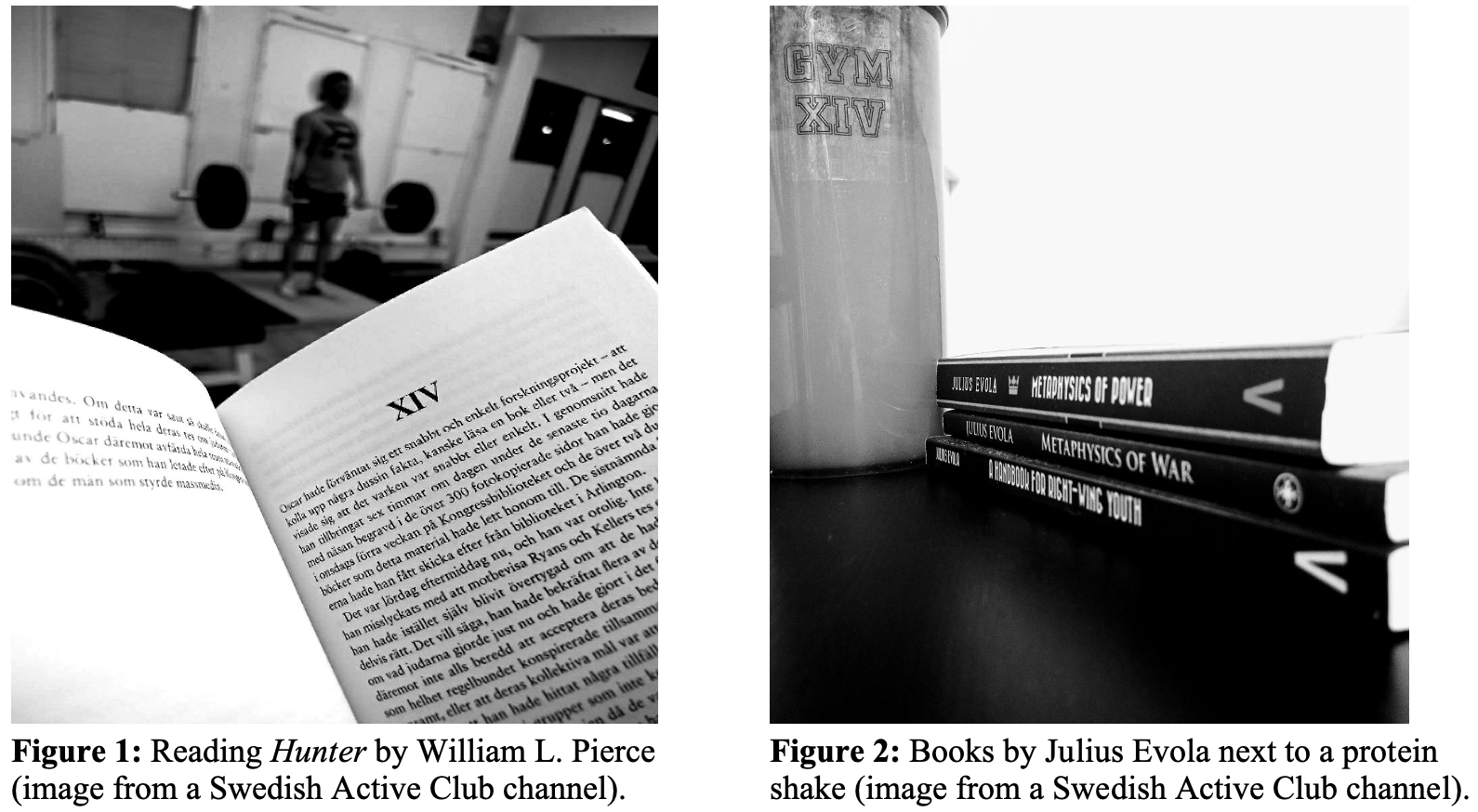
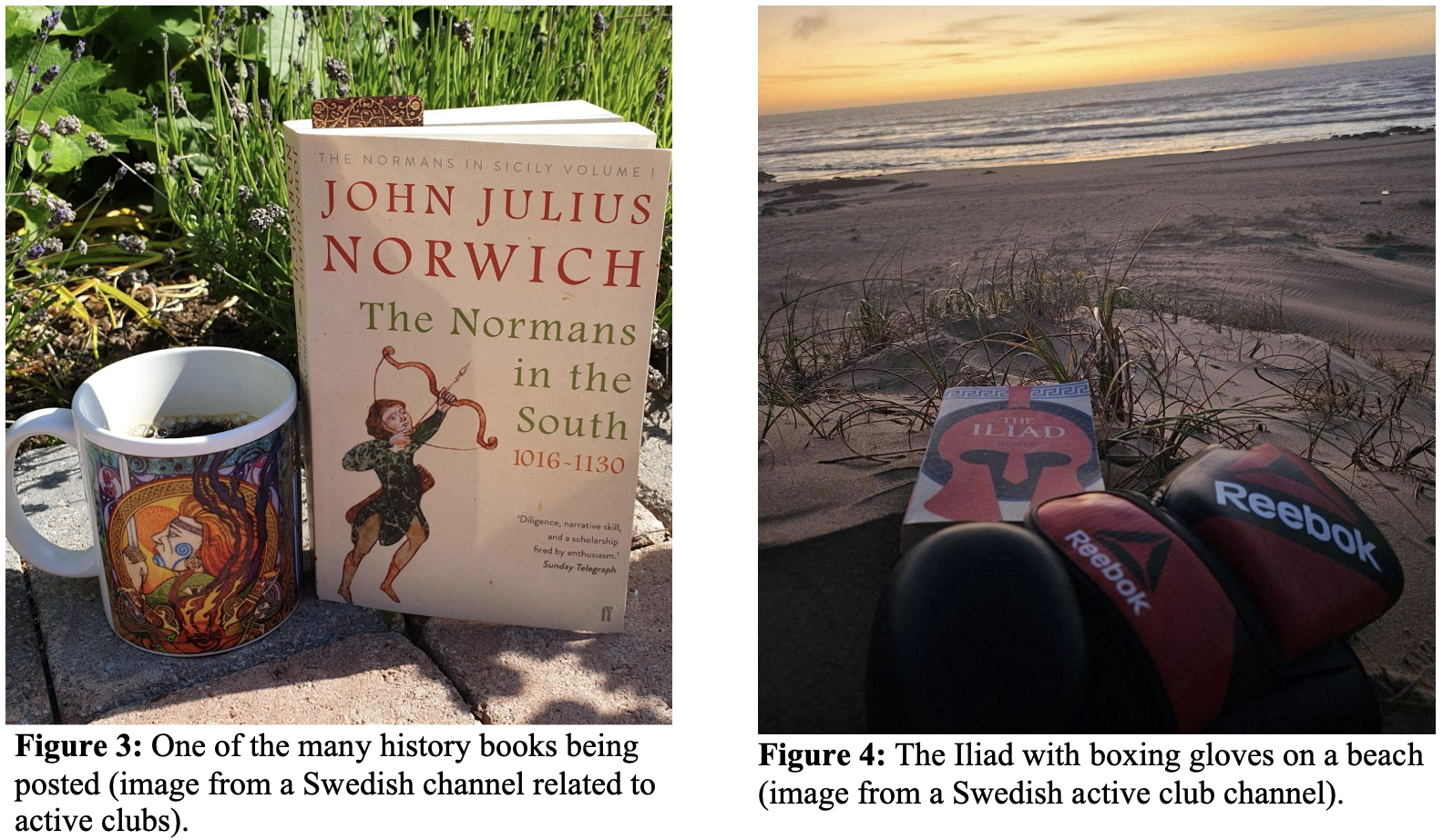
The Telegram channels also uncover a strong interest in more mainstream classical literature, western philosophy, and history books (see Figure 3). Friedrich Nietzsche (who has historically been used to legitimize fascist ideas), Homer, and Marcus Aurelius are some of the more popular authors. According to Ravndal, the 21st century far-right has shifted from “violent skinheadism to bookish identitarianism.” This shift is reflected in the Telegram channels we studied: the skinhead aesthetic is very much out, and now replaced by travel content, chess boards, and sportswear, often with a literary twist (see Figure 4). The Swedish influencer behind one of the channels has criticized far-right street fighting and violence, labelling these actions “primitive”. While training your body is an important part of being a man that can defend his family and nation, he says, what really matters when it comes to gaining political power is a trained and cultured mind.
The form of intellectualism seen in the Telegram channels is closely linked to the far-right’s appropriation of classical history. The far-right’s broad utilization of the aesthetics of ancient Greece and Rome can be seen as a metapolitical strategy for supporting an imagined idea of European civilization. Aside from the overwhelming emphasis on Homer and Aurelius, Telegram posts containing literary references are also often shared in relation to visuals of classical art and architecture. Here, the idea of the superiority of white Western achievements is (to some degree) hidden behind a celebration of world heritage. Through taking advantage of mainstream appreciation of culture, while at the same time glorifying masculine whiteness, western civilization becomes code for white civilization. Like a meme shared on one of the channels states: signs of a child becoming a far-right extremist are, among others, that he has an “appreciation of nation, history and culture” and a “growing collection of classical literature”.
The Disciplined Man: Self-development in the context of gender roles and misogyny
“Set goals and go for them (…)
Get a sixpack
Learn a new language
Elevate or learn a new skill for income
Connect with like minded men [sic]
Then come back to me if your [sic] depressed.”– Direct quote from a Norwegian telegram channel associated with the Active Club network.
In the last two years, a public discourse around the so-called “man crisis” has developed in the Norwegian media (see also here, here, and here). This discourse highlights the contact points between ideas of what it means to be a man, self-development, and social media platforms. Influencers like Andrew Tate and Elias Omberg purport to guide young men on an optimization journey that involves working out, getting enough sleep, eating healthy and organic, not drinking alcohol, and not watching porn. These self-disciplinary and social media-fuelled trends are also linked to the recent reactionary shift of boys and young men leaning to the right side of politics.
The literature-related content from the five channels is usually posted in the form of motivational quotes by mentioned authors, or in the form of images of books together with self-disciplinary captions written by the creator of the posts. The fact that the masculine self-development trend is as prevalent in the far-right digital space as it is in the mainstream, exemplifies that – at least when it comes to the central point of manhood – the gap between the far-right and the mainstream has become smaller.
Cynthia Miller-Idriss writes that men’s search for meaning and self-improvement can lead to hatred towards women. Her studies show that workout-related searches on TikTok can take you on the path to misogynistic content. According to Miller-Idriss, algorithms are turning a manhood crisis into a misogyny crisis (which will be discussed in her forthcoming book Man Up: The New Misogyny and the Rise of Violent Extremism). The Active Club Telegram channels reflect Miller-Idriss' analysis, as they celebrate the trad-wife movement and correlate women’s “lack of beauty” with liberal feminism. If women are included in references to literature, it is within the narrative that being well-read (and ripped) will make men more attractive to beautiful women.
Becoming a Renaissance Man: Legitimizing the far-right
Of course, the use of literature and the importance of intellectualism is nothing new to the far right, commonly seen in several far-right contexts through the 19th and 20th centuries. What is concerning for today’s liberal society, however, is the use of intellectualism to normalize the far-right, especially in the light of masculine self-development, and especially among young men and teenagers. Furthermore, this serves to evoke a feeling of belonging and brotherhood, through the idea of achieving goals together: Reading, playing chess, and working out are all done as part of a community. All-in-all this shows the holistic approach the far right takes to draw supporters: Gone is the contemporary notion of brutish men with only a desire for physical violence. Today’s far-right Renaissance man drinks organic coffee, reads Homer, and owns a chess board.