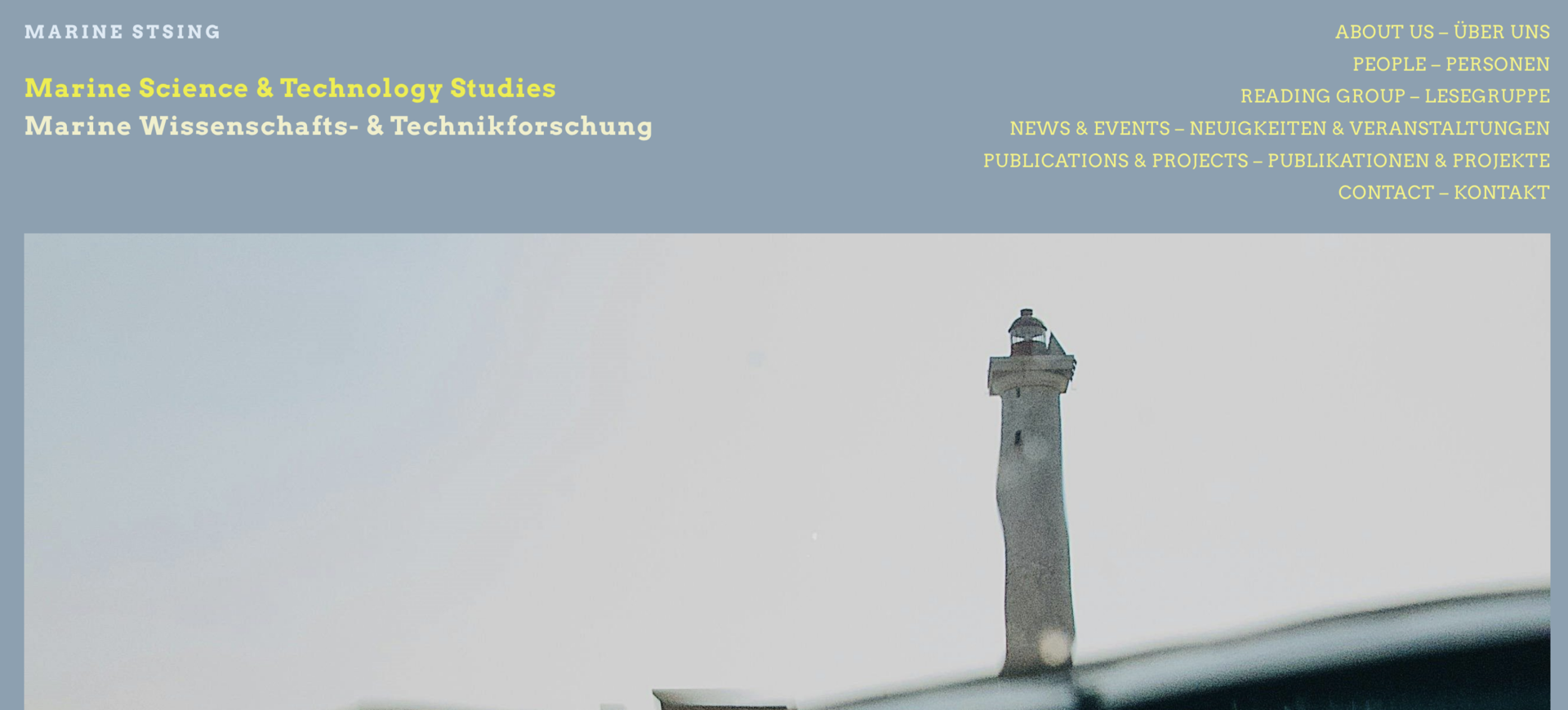
The talk was given for the newly established Marine Science and Technology Studies group, which unites researchers from the humanities, social science and natural sciences to discuss the development of the ocean and marine life:
"Anthropogenic pressure on coastal areas, rising seas, overfishing and marine biodiversity loss impact both marine life and society. Scientists from within different disciplines grapple with these dynamics. Marine stsing offers STS scholars who work on marine worlds and oceanic life-forms the opportunity to engage in lively discussions, joint projects, and scientific activities. The group consists predominantly of scholars from the marine humanities and social sciences, but also invites colleagues from the natural sciences, technicians, and engineers who work on marine realms. We understand ourselves as an open space where different epistemic cultures meet. Our work is situated in the current Ocean Decade (2021-2030), declared by the United Nations. We think that STS, still rather invisible within the UN Ocean Decade’s activities, can explicitly contribute to those, enhancing STS’s translational approach within, through and beyond them. This includes, but is not limited to, the creation of nature-society-based solutions considering trade-offs between economic and ecological interests, the discussion on how to combine STS-marine social sciences with critical sociologies of knowledge, and the development of practical solutions to some of the challenges the world’s oceans currently face. A core strategic goal of marine stsing, thus, concerns the strengthening of marine STS on diverse academic and institutional levels in Germany and beyond.
Our group began its work in the summer of 2022 with the hope to create inspiring exchange among marine STS scholars and research communities, which, in our understanding, have been very much separated from one another. Initially, it were members from the strategy group “Marine Social and Cultural Sciences” within the German Consortium for Marine Research who engaged with approaches from within STS, framing their research in corresponding theoretical terms, who had the idea to establish a reading group. The group is is organized by Tanja Bogusz (Hamburg University), Ramona Hägele (Würzburg University and IDOS Bonn) and Laura Otto (Würzburg University). Our group commenced as an online reading group. Over time, we have become a working group within stsing e.V., which provided not only a more institutionalized format, but also the chance to grow as a group and to reach more colleagues. We have not only discussed our own projects and papers within the group, but have invited senior STS scholars such as Stefan Helmreich or Casper Bruun Jensen to discuss their contemporary work on marine realms."
Read more about the group's work and activities on their webpage.