Violence and hate crime
Mapping and explaining patterns of extreme right violence and hate crime, including harassment, treats and hate speech.

Extreme right violence and hate crime
A hallmark of extremism, including right-wing extremism, is its justification of violence, whether immediate or deferred. In this context, right-wing extremist movements often identify two categories of perceived enemies against whom violence, threats, and harassment might be justified: external enemies such as Jews, Islam/Muslims, or Communism; and internal enemies, including national or racial "traitors," political adversaries, the "system", multiculturalists, and mainstream media.
While these ideologies occasionally manifest as violent attacks, more frequently they result in harassment, threats, and hate speech. Hate crimes, defined as acts driven by hatred or prejudice against specific groups, are recognized in the penal codes of many countries, although varying definitions can make comparisons challenging.
At C-REX, scholars are actively studying these phenomena, mainly in liberal democracies, applying both qualitative and quantitative methods from a variety of perspectives.
Key questions
- What is the distribution of right-wing extremist violence across countries and over time?
- What is the modus operandi of contemporary perpetrators of right-wing extremist terrorism?
- What restrains individuals and groups holding militant and hateful view from carrying out actual violence?
- What is the impact and consequences of extremist violence, treats or hateful harassment on those targeted?
Projects
HATECYCLE: The life cycle of hate crimes - Patterns, responses and consequences
The project HATECYCLE will investigate the life cycle of hate crimes in Norway to improve our understanding of its patterns, the societal responses to hate crime and their consequences, using these insights to guide more targeted prevention and intervention.
Resources
- Right-wing violence and terrorism (in Norwegian)
- Right-wing extremism in Norway (in Norwegian)
Right-wing terrorism and violence in Western Europe: the RTV dataset
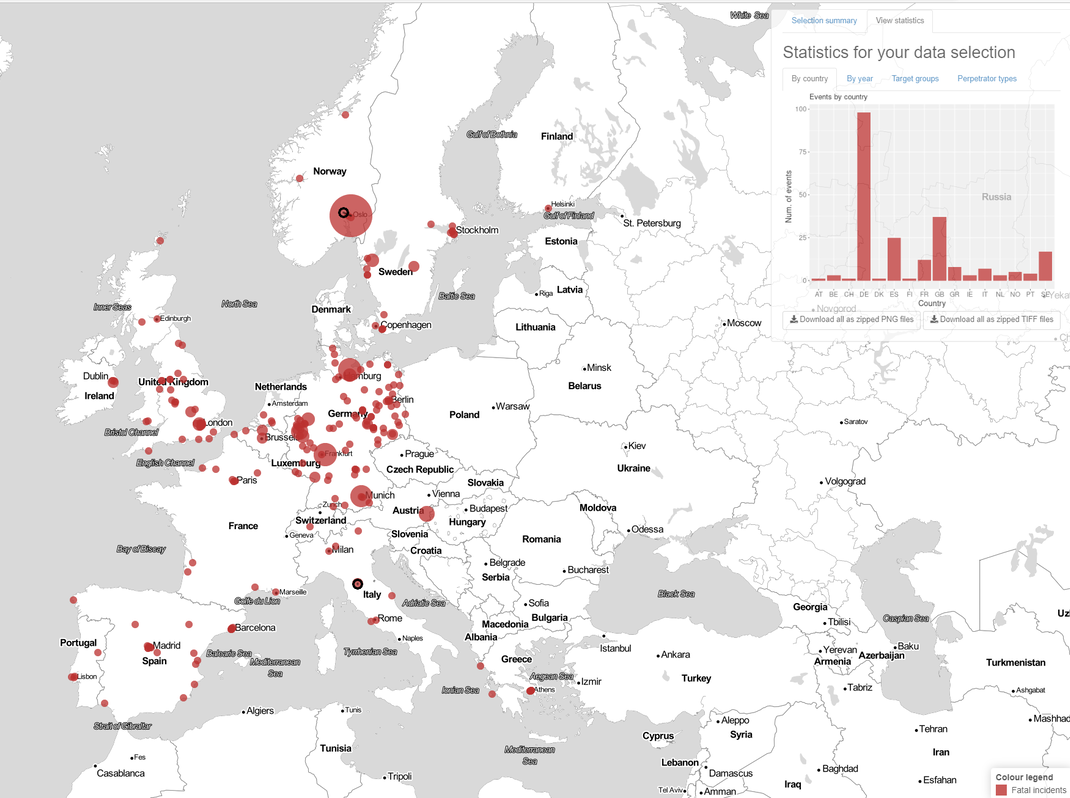
The RTV dataset documents right-wing terrorism and violence in Western Europe since 1990. Each event has been coded on a range of variables, including time and location, perpetrator and victim characteristics, organizational affiliations, weapon types, and number of casualties.