Update made on 25.02.2026: Please note changes under "teaching" and "examination".
This is an iteration of SOSANT9100A/B Recent Theory in Anthropology.
Course convenors: Professor Andrew Mathews (UC Santa Cruz) and Professor Marianne Lien (University of Oslo).
Guest speakers: Professor Anna Tsing (UC Santa Cruz) and Professor Knut Nustad (University of Oslo).
About the course
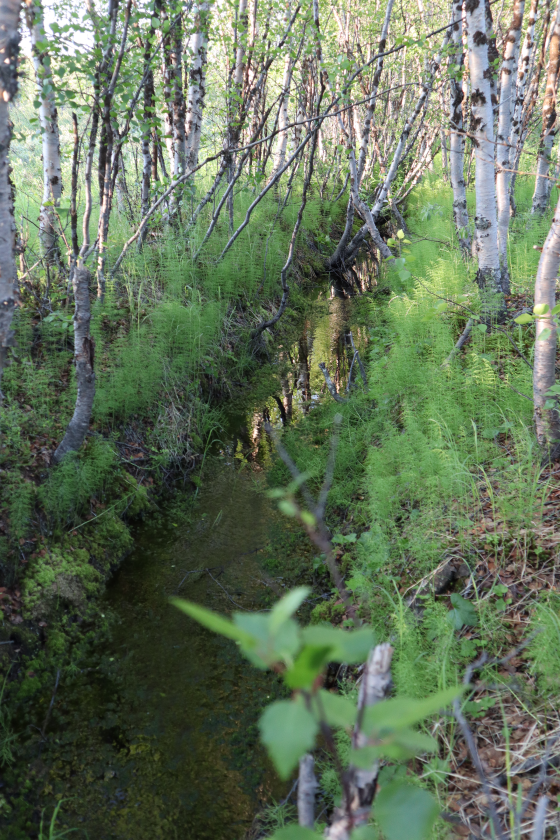
Anthropologists are increasingly moving beyond thinking of landscapes as ideological and conceptual constructs, to focus instead on dramatic encounters between humans, plants, animals, soils, and waters. This ‘more than human’ anthropology of landscape and landform is inspiring theoretical and methodological experimentation in drawing ethnographic attention to the role of political, ideological and agricultural projects in reshaping terrain, shifting the flows of rivers and marshlands, and shaping the forms of trees and plants. We mobilise the term political geomorphology to think about how political, social, ecological, and abiotic processes are intertwined, as well as the implications of such entanglement. Through readings and discussions, we will explore the pathways through which state policies, scientific ideologies, and rural abandonment have transformed burning, grazing and drainage regimes, with immediate and long-term consequences, drawing on examples from across Europe and around the world. This innovative anthropological approach bridges political, social, ecological and geomorphological processes with a focus on ecosystem shifts and emergent landscape form.
We gather at the research station Svanhovd in the Pasvik, Finnmark, near the Norwegian-Russian border. The Pasvik valley is marked by an exceptionally deep and layered history. Using the land- and waterscapes of the Pasvik valley as a pedagogical field site, participants will study landscapes as assemblages that bear traces of multiple layers of land-use, state promoted agricultural regimes, military operations, mineral extraction and rural abandonment. We will teach a methodological toolkit that includes an expanded archival approach, landscape walks, and visual and creative methods for recording plant and landscape form, as well as collaborative research with natural scientists and local experts. This expanded landscape ethnography builds upon our expertise in the anthropology of environmental science and policy, in landscape ethnography, and in historical ecology. Students are expected to have read the assigned texts in advance.
The course is part of the INTPART research program at the Department of Social Anthropology, and seeks to enhance theoretical, interdisciplinary and ethnographic skills in a hands-on and explorative manner. We invite participants with an interest in shifting landscapes in the Nordic Arctic and elsewhere. Funding for accommodation at Svanhovd is provided by INTPART. This includes local transport between the research school and Kirkenes airport. Travels to and from Kirkenes will be covered by PhD participants through their own funding. Participants from INTPART partner universities will be prioritized and their travels and accommodation will be fully funded (University of Oslo, University of Cape Town, University of the Western Cape, University of Tokyo, and University of California, Santa Cruz).
Teaching
The course is designed and taught by Professor Andrew Mathews (UC Santa Cruz) and Professor Marianne Lien (University of Oslo) with guest speakers Professor Anna Tsing (UC Santa Cruz) and Professor Knut Nustad (University of Oslo).
The course combines lectures, seminar activities, landscape walks and writing assignments. A detailed program for the whole course will be circulated in advance to registered participants.
Participants are expected to do engage with all the readings before the course and think about how the literature might help them reconsider the landscape in which they are conducting research. A preliminary reflection on how this may be developed in their essay, must be submitted prior to the course (300-600 words) .
Admission to the course
You must be admitted to a PhD programme to enrol in this course and receive credits via UiO. The course is targeted toward PhD students in the social sciences and humanities, with a focus on Social Anthropology. However, applications from students in other fields, such as environmental studies or other fields of relevance to the topic will be considered. Priority will be given to candidates from INTPART partner universities (University of Oslo, University of Cape Town, University of the Western Cape, University of Tokyo, and University of California, Santa Cruz).
How to apply
PhD candidates from the Department of Social Anthropology, University of Oslo: apply by using Studentweb.
Other PhD candidates: apply by webform: https://nettskjema.no/a/544794
Please include:
• A short CV
• Institutional affiliation
• Short motivation statement and explanation of course relevance (300 words)
Application deadline: 1 April 2026
Examination
Within two months after the course, participants must submit:
An essay based on course readings, discussions and field experiences, preferably related to the student’s own research project. Total length: 3-4000 Words, including footnotes.
Full participation (and pass) equals 5 credits.
You may take part in the course without submitting an essay and will then not be awarded credits. Please inform the Department when you apply if you wish to participate in the course without submitting an essay.
For more information, visit the course page (SOSANT9100A)