About BabyLing
We are an infant-research lab that focuses on early language development.
There is a remarkable variability in language development across children: while one infant may produce over 100 words at the age of 16 months, another infant might still have not pronounced a single word by the same age. Yet, both infants are within the range of typically developing infants. Thus, early diagnostic is extremely difficult and early intervention is rarely possible. Yet, we know that while some low-scoring infants will catch up easily with their peers and without further consequences, others will struggle throughout early childhood and will never achieve the same level of academic achievement as others.
To minimise and, in turn, prevent learning difficulties, we need to understand why some infants are delayed in their development from a very early age. Large differences in cognitive performance between infants are not uniquely driven by genetic differences; the learning environment plays a crucial role in cognitive development.
To this end, developing a finer comprehension of the roles of parental input, of the structures of the household and of the community is a mandatory first step so that policy makers can make informed, data-driven decisions to narrow the gap between low and high achievers, even before children enter formal education.
Our Objectives
- Establish reliable tools to assess early vocabularies
- Examine the role of the learning environmental on early vocabulary acquisition
- Identify language learning mechanisms used by young children
Participate
Do you have a child below three years of age? Are you interested in contributing to the advancement of our knowledge on how children learn languages?
We run studies both online - you and your child would take part into our studies from the comfort of your home, using your own device (computer, tablet or phone) - and in-person - at the Department of Psychology of the University of Oslo.
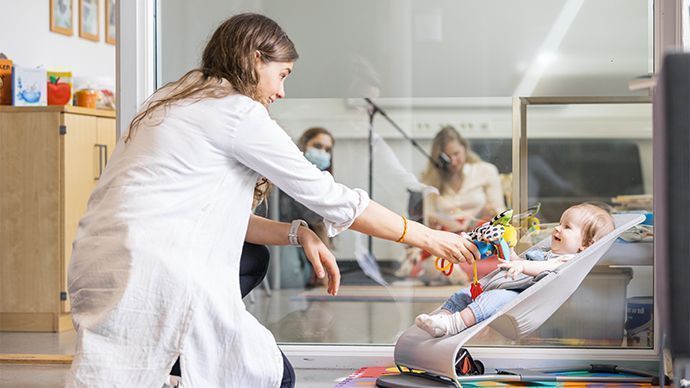
Our in-person studies typically last less than 15 minutes, with the total duration of your visit about half an hour, although you are welcome to stay longer if you have questions! Your visit typically includes some playtime with your child (you are with your child during the whole duration of your visit) and, after that, your child (and you) will watch brief animations or pictures on a screen, accompanied by sounds or speech. While your child watches the screen, we will use an eye-tracker to measure how long your child looks, where your child looks, or measure your child’s pupil size. Each study is a little different, and we will be happy to tell you more if you are interested at baby-ling@psykologi.uio.no.
At the end of your visit, your child will be rewarded with a small gift, and you will get the opportunity to ask any questions related to our research.
Currently, we have in-person studies for 6-18 month-old babies and a nation-wide online study for 18-36 month-old toddlers. If interested, please contact us at: baby-ling@psykologi.uio.no !


FAQ
How long does a visit last? The screen task usually takes only 5–15 minutes, but we set aside about 30 minutes in total so the child has plenty of time to get comfortable and play a bit first.
Does my child have to sit perfectly still? Not at all! We are very used to toddlers moving around. We use a small sticker on the forehead that helps the eye-tracker follow their gaze even if they move their head.
What if my child starts crying or gets restless? We can take a break or stop immediately. The child’s comfort is our priority, and we want it to be a positive experience for both of you.
What is my role as a parent during the test? You will be with your child at all times. All we ask is that you try to sit quietly and avoid pointing at the screen or talking to the child during the measurement, as this ensures the data is as accurate as possible.
What data is being recorded? We don't record video of the face in a traditional sense; the equipment only tracks where on the screen the child is looking and for how long.
Is there a place for my stroller? Yes, there is plenty of space to park strollers inside the institute.
Location
All our in-person studies take place in our baby-friendly lab at the Department of Psychology, University of Oslo:
Forskningsveien 3A, Harald Schjelderups hus, 0373 OSLO.
We are located less than 10 minutes walking distance from Blindern metro station. Forskningsparken metro and tram station, or Gaustad bus station. If you prefer to drive, there are parking options right outside building. You will be offered to be reimbursed for travel or parking expenses.
Overview of Ongoing and Recent Studies
Read more about our research.
Tools
Eye-tracking, tablet-based paradigms, acoustic analyses, online studies, imitation games, computational modelling.