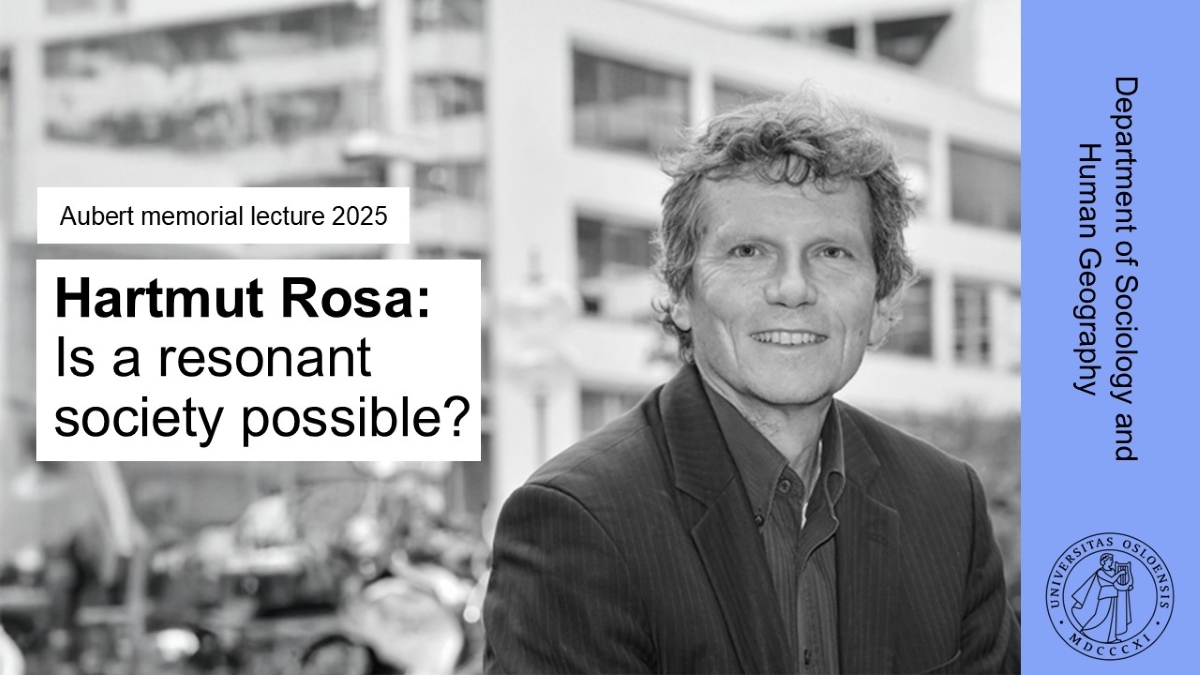
Hartmut Rosa, sociologist and social philosopher, is coming to Oslo to deliver this year's Vilhelm Aubert Lecture. Rosa is renowned for his original analyses and critical perspectives on late modernity. He has elaborated on how the increasing acceleration that marks our era contributes to human alienation - alienation from other individuals, nature, society, and oneself. In response to these issues, he argues that both society and individuals require resonance, a reverberation, grounded in phenomenological thinking.
In two different events, Rosa will discuss the institutional prerequisites for cultivating a resonant society and a well-functioning democracy.
About the Vilhelm Aubert memorial lecture 2025
The Vilhelm Aubert Memorial Lecture is a collaborative event between the Department of Sociology and Human Geography at the University of Oslo and the Institute for Social Research. The programme is divided into two parts: the Aubert Lecture and the Aubert Debate.
During the lecture, Rosa will draw upon his previous analyses of acceleration, alienation and resonance, offering fresh insights into the interplay between institutional conditions and individual experience in the development of a resonant society.
The Aubert Debate centres around the same key concepts, with Rosa exploring the implications of acceleration on democracy and the public sphere - and how resonance might help address the "crisis of democracy". Following the introduction, Rosa will engage in discussion with Norwegian social researchers.
Both the lecture and the debate will be conducted in English.
Programme
The Aubert Lecture – Perspectival Dualism: Resonance as a Subjective Experience and an Institutionalized Relationship
April 24th, 14:15 - 16:00
Ragnar Frischs auditorium 1, Eilert Sundts hus
The lecture is open to the public and there is no registration.
There will be a book signing at Norli Blindern after the lecture (16:15 - 17:00).
Summary of the lecture
One key element of Vilhelm Aubert’s influential work and thinking is his interets and capacity to link the micro- and the maco-perspectives in sociology. That is to say, he was equally interested in the structural logics and functionings of social institutions as in the experiences, and the well being, of individuals. The lecture will take up on this and argue for a perspectival dualism in sociology which systematically links a structural and institutional analyisis of modern ‚acceleration societies‘ with a phenomenological account of subjective experiences. It is the subjects‘ hopes, desires and fears that ‚drive‘ the institutional modes of dynamic stabilization – but these hopes and fears, of course, are in turn molded and shaped and sometimes produced by institutions. To this end, the lecture will seek to show that alienation as well as resonance can be simultaneously analysed as objective forms of relationship (identifiable from a third person perspective) and as subjective forms of experience (identifiable from a first-person perspective only). It will end by outlining the contours of a "resonant society".
The Aubert Debate – Callability and Alienation: Social Energy, Political Discourse and the Crisis of Democracy
April 25th, 09:00 - 11:00
Institute for Social Research, Munthes gate 31
The debate will begin with a presentation by Rosa on the significance of acceleration for democracy and how resonance can help address the "crisis of democracy." Following the introduction, Bjørn Schiermer Andersen and Grete Brochmann from the Department of Sociology and Human Geography at the University of Oslo (UiO) will provide comments before Rosa joins them for a debate.
Coffee and croissants will be served from 08:30. Register for the event at the Institute for Social Research's websites.
Summary of the debate
Vilhelm Aubert’s sociological focus and interest clearly was on the forms, modes and functionings of social relationships and interactions. He was interested in the subjective experiences, emotions and motives guiding interactions – for example in institutions like ships, in competitive environments, even in sleep – but just as much, of course, in the social institutions shaping, regulating, coordinating and guiding those relationships. Now clearly, democracy needs to be conceived of as a mode of interaction between citizens. As such, it is formed by political institutions as well as by political culture and public discourse. Hence, the dominant mode of interaction might be antagonistic and lead to experiences of political alienation – or it might be responsive and lead to a mode of ‚resonance‘ in and through interactions. For this, of course, it is important not to confuse resonance with consonance. The contribution will seek to establish the idea of institutional as well as subjective ‚callability‘ and ‚respons-a-bility‘ as key requirements for a vibrant, functioning public sphere and democracy, and it will explore the effects of digitalization on the political mode of interaction.
About the lecturer
Hartmut Rosa earned a doctorate in 1997 from Humboldt University in Berlin, focusing on the political philosophy of Canadian philosopher Charles Taylor. In 2004, he completed another doctorate with his thesis Social Acceleration. The Transformation of Temporal Structures in Modernity at Friedrich Schiller University in Jena, where he has been a professor of sociology since 2005. Since 2013, he has also served as director of the Max Weber Centre for Advanced Cultural and Social Studies at the University of Erfurt. Among his significant works translated into English are Social Acceleration: A Theory of Modernity (Columbia University Press, 2015), The Uncontrollability of the World (Polity Press, 2020), and Resonance: A Sociology of Our Relationship to the World (Polity Press, 2021). In 2024, parts of Rosa's writings were translated into Norwegian and published in the book Acceleration and Resonance: Articles and Life in Late Modernity (Cappelen Damm, 2024).
About the annual Vilhelm Aubert memorial lecture
Each year, a distinguished international sociologist is invited to Oslo to deliver the Vilhelm Aubert Memorial Lecture and engage in discussions with Norwegian social researchers.
The memorial lecture was established in 1991 to celebrate outstanding sociology and general social analysis, thereby honouring the legacy of Norwegian sociology's patriarch, sociologist and lawyer Vilhelm Aubert (1922–1988).
The first to hold the Vilhelm Aubert Memorial Lecture was Robert K. Merton. In subsequent years, notable figures such as Pierre Bourdieu, Jürgen Habermas, Arlie Hochschild, Howard S. Becker, Michele Lamont, and Patricia Hill Collins have visited Oslo.
The memorial lecture is comprised of two segments: an open lecture at the University of Oslo and an academic debate at the Institute for Social Research’s premises in Munthes gate.