Associate Partner: Haus Am See – Informationszentrum für Umwelt und Naturschutz
In this research project, I examine the politics around situated forms of environmental knowledge and expertise and how they translate into specific human-environment relationships and practices rendering the picturesque post-mining landscape of Bitterfeld-Wolfen in Eastern Germany a political arena.
In particular, I am interested in how differing perceptions of the environment shape corresponding ways in which local residents, entrepreneurs, administrators, activists, politicians, and other stakeholders relate to and intervene with the surrounding landscape. Here, landscape, human life, and other-than-human livelihoods have been inextricably connected throughout a shared history of radical socio-economic, political, and ecological transformations that continue to inform possibilities, subjectivities, and livelihoods today.
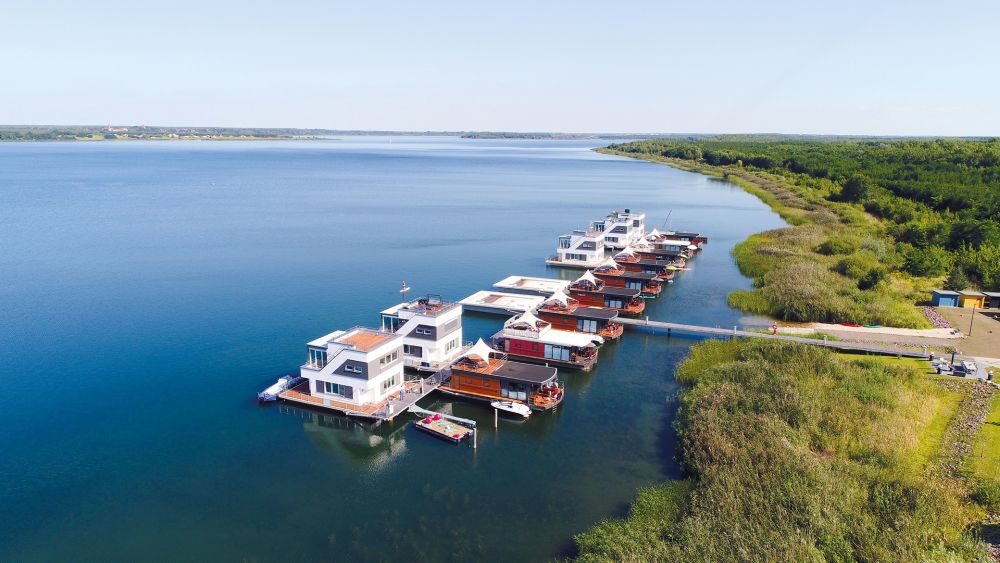
Taking the quiet twin-town Bitterfeld-Wolfen as a point of spatial reference, this study encompasses the wider area and thus the villages, idyllic lakes, nature reserves, and large agricultural fields that surround Bitterfeld-Wolfen. The wider region is home to ca. 50.000 inhabitants, roughly half of the population compared to thirty years ago.
The lakeland attracts day trippers from the region but also proper tourists from the Baltic Sea and even Switzerland who appreciate the natural beauty, tranquillity, and not least the almost miraculous transformation of the destroyed landscape that preceded today’s idyll. For, the lakeland is the recent and seemingly paradoxical consequence of more than 100 years of coal mining, chemical industry, pollution, environmental destruction, and ecological restoration.
The presence of coal had been known at least since the 16th century, while its exploitation remained limited to local, often feudal endeavours, which morphed into entrepreneurial projects since the 1830s. The decisive shift towards large-scale resource extraction and heavy industrialisation was initiated by Bitterfeld’s integration into the railroad grid in 1857, repositioning the hitherto rural periphery at the crossroads of important transport connections to Berlin and other urban centres. The availability of affordable energy and cheap labour turned the “empty” region into an economically lucrative site for energy-intense chemical industries, attracting companies like the photochemical producer Agfa. Until World War II, Bitterfeld-Wolfen had transformed into an industrial and mining hub, with a rising urban population. Following the establishment of the German Democratic Republic (GDR), or East Germany, mining and chemical production were further expanded, developing the region into the “pharmacy of the GDR” but also, infamously, into the “filthiest town in Europe” (Maron 1981) given the extreme levels of pollution and environmental destruction that have been integral part of the chemical and mining industries since the 1890s.
Environmental issues, then, were central to the civil movement in East Germany that eventually toppled the GDR regime in the Peaceful Revolution of 1989/90. The following German reunification brought about fundamental political, social, economic and existential ruptures. In Bitterfeld-Wolfen, deindustrialisation, the shutdown of coal mining and large parts of the chemical industry resulted in dramatic layoffs and socio-economic upheaval but also initiated the clean-up of contaminated sites and extensive restoration of the mines. Today, the pretty landscape that was build under these efforts, is deeply appreciated by locals not only for its ecological recovery but, importantly, also for its significance regarding local residents’ re-appropriation of their socialist past as well as their claim to the post-socialist present. This interconnection of ecological and social rehabilitation is one example of how human and more-than-human life has constituted one another – deeply anchored in place and across any presumed nature-culture-divide.
Against the background of this layered human-environmental history and its complex legacies, the restored and re-industrialised landscape has become Contested Ground, I tentatively argue, an arena for and issue of political conflict. From a methodological point of view, I treat the transformations in the Bitterfeld-Wolfen region since reunification as generative of new forms of environmental knowledge and (claims to) expertise that are expressed as authority to act and intervene in specific ways. In doing so, the project seeks to address the simultaneity of issues as diverse as persistent toxicity, land use and nature protection, the restored landscape as public good and its appropriation for private value extraction, successful re-built of the chemical industry, steady outmigration, the post-socialist boom and bust of the solar energy industry, social disintegration, and not least increasing popularity of far-right political movements.
Relevant literature:
Maertens, C. (2024). What’s in a landscape? Nature, memory, and tourism in Bitterfeld-Wolfen’s post-mining landscape, East Germany. Landscape Research, 49(7), 1001–1014. https://doi.org/10.1080/01426397.2024.2397598
Maertens, C., & Berglund, E. (2024). Conservation and multispecies relations in the making of contemporary European tourism environments. Landscape Research, 49(7), 929–933. https://doi.org/10.1080/01426397.2024.2407039