Carolin's talk at the BIOrdinary Conference
Carolin presented her work at the BIOrdinary Conference (May 18-20, 2026) at the Department of Social Anthropology of Stockholm University. The conference was the concluding event of the research project “BIOrdinary: Biodiversity dilemmas in ordinary places” that seeks to expand our understanding of biodiversity in “ordinary places” that currently fall outside global biodiversity agendas.
Carolin’s paper on “Socialist mess. Political aesthetics of environmental disaster and restoration in reunified East(ern) Germany” contributed to the panel on “Messy Natures”, which also featured the fantastic work by Tomas Cole, Christina Fedengren, Jamie Lorimer, and Paula Uimonen.
Apart from further exciting panels, the conference programme also included a thought provoking keynote lecture by Andre Mathews on “Invasiveness as a response to ecological escape, landscape change and disturbance: Rapid evolution in human transformed landscapes” , the showcasing of popular science work by the BIOrdinary research team, the screening of the fascinatingly unsettling film “Unanimal” (2025) by Sally Jacobson and Tuva Björk , and a visit to Roland Persson’s atelier.
Concerns for the ecology are always political, not only in A Landscape of War: Ecologies of Resistance and Survival in South Lebanon.
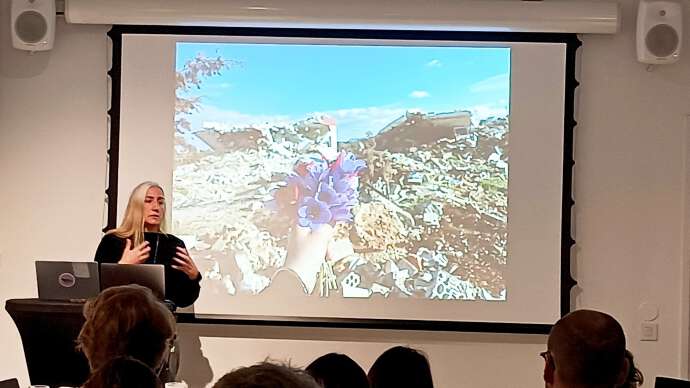
In her presentation, Munira Khayyat documents the war raged by the Israeli State against Lebanon and how it continues also under the official ceasefire with devastating attacks on people, settlements, and entire landscapes that eradicate not only current life but all life that could have been. In South Lebanon, the future of human-environment catastrophe is now.
Carolin's talk at OCEH Seminar Series (March 2026)

On 23 March, 2026, Carolin gave a talk at the Oslo Center for Environmental Humanities’ Seminar Series titled “At the receiving end. The politics of energy transition in rural Eastern Germany”. Drawing on insights from her most recent fieldwork, in this talk Carolin developed the conceptual framework for her enquiry into how the energy transition is experienced politically on the ground in rural Eastern Germany.
Abstract
In 2023, German federal legislation granted “overriding public interest” to the expansion of renewable energy production facilities, a principle that was subsequently inscribed into spatial planning down to the local level. Based on preliminary fieldwork, this presentation traces the concrete effects produced by this built-in scalability through the case study of a new wind park currently in planning. A tentative analysis suggests that recent legislative shifts enable a profound reframing of land as merely an energy source, trumping other forms of value, and of citizens as risk factors to the realisation of renewable energy projects, who are therefore subjected to mitigation strategies rather than meaningful participation in decision-making.
Carolin's fieldtrip to Bitterfeld-Wolfen (March 2026)
At the beginning of March, Carolin spent a week in the Bitterfeld-Wolfen region for her second stretch of fieldwork. This time, the research trip focused on two core themes of her work in the region: first, the ongoing restoration of former mine pits that were used as dump sites by the chemical industry until their closure in the early 1990s; and second, the construction of renewable energy facilities in the context of recent, rapid, and fundamental changes in federal legislation.

Practically, Carolin visited the site of a former mine pit that is currently under restoration and learned in depth about the procedural and technological innovations this endeavour has required, as there was no blueprint for the particular challenges this site poses. Crucially, however, concerns of nearby residents also play an important role in planning and carrying out concrete works.
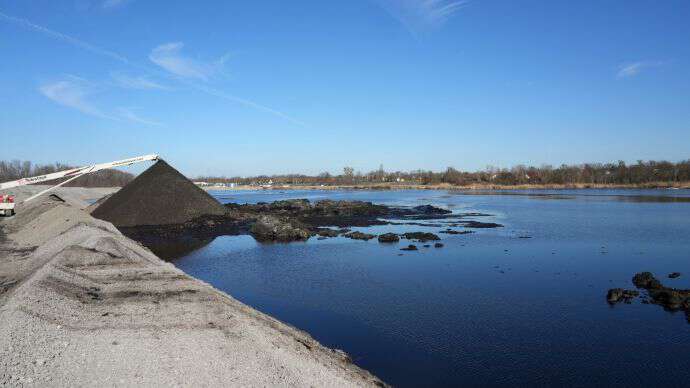
With regard to new renewable energy projects in their planning phase, Carolin explored the complex stakes involved in specific projects prompted by the “overriding public interest” that federal legislation has granted the expansion of renewable energy production facilities since 2023. Energy production, however, always takes place on the ground, in specific sites inhabited by people, animals, and plants whose lives are intimately entangled.
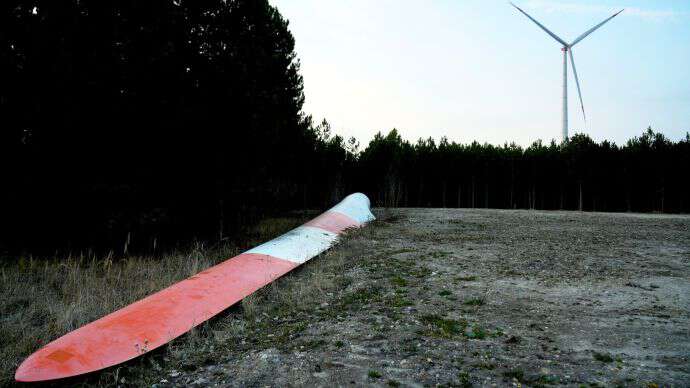
With this in mind, Carolin is interested in understanding how global concerns about climate change are translated into national law that redefines the conditions under which people (can) relate to their immediate environments. To this end, Carolin has reached out to various stakeholders and engaged in conversations about local livelihoods in rural settings, the value of forested land, shifting uses, and about energy futures tied to energy pasts in an area profoundly shaped by large-scale coal mining.
Carolin's talk at LandUse Seminar Series (February 2026)

Carolin gave a talk in the LandBruk Seminar Series, hosted by the Nordic Laboratory research group at the Department of Social Anthropology at the University of Oslo. In her contribution, titled “At the receiving end. The politics of energy transition in rural Eastern Germany”, she explored the effects of recent federal legislation in Germany that profoundly intervenes in spatial planning at the local level. Specifically, Carolin introduced her case study on the construction of wind turbines in rural eastern Germany and the contestations that this planned project raises.
Carolin at Conference on Knoweldge Exchange and Slow Hope

Together with other members of the RURALEX team, Carolin attended the kick-off conference for the network project Knowledge Exchange for Slow Hope (KESH) in Nottingham (UK) on 25.-26. November. KESH is a knowledge exchange programme accompanying the HERA/CHANSE Joint Research Programme Crisis – Perspectives from the Humanities and aimed at bringing together researchers from the 10 funded CRISIS research groups, HERA funders and external stakeholders. KESH supports communication and collaboration to nurture strong cohort relationships to create foundations for future partnerships. The programme is led by Professor of History & Memory Studies Jenny Wüstenberg (Nottingham Trent University) as Knowledge Exchange Fellow (KEF).

The title of the programme and conference—Knowledge Exchange for Slow Hope—defined the very approach towards both, the long-term initiative KESH and the event we attended in Nottingham. Accordingly, the conference offered frmats that gave space and time to immerse in longer conversations about various research projects, individual and collective experiences, practical approaches to doing research, about excitement but also challenges and uncertainties and, not least, about hope for the changes we would like to see.
Slow, here, is the mode that allows for a meaningful exchange across disciplines, methods, research interests and perspectives. By resisting the urge for immediate output, slow is ambitious in a different way: Talking from various academic, disciplinary and personal dispositions, meaningful exchange depends on genuine interest beyond the familiar and on effort invested into an open-ended process. This is were hope emerges as a tentative idea of what could be possible.

Practically, researchers, academics in managing roles and representatives of funding agencies met for group work sessions and trainings, paired up for walks, listened to one another in plenary sessions and individual conversations.
Personally, I was intrigued by the map making practices in the context of indigenous people’s struggles for reclaiming land. This was complemented by conversations around colloquial mental maps of (health) crises and how people map their locally grounded experiences in ways radically different from administrative spatialised depictions of (health) crises.
On another note, a session on policy making and research in the humanities was very helpful to think anew about ways in which our research findings can contribute to policy making and thus to shaping lived realties.

Carolin's fieldtrip to Bitterfeld-Wolfen (October 2025)

In October, Carolin has spent two weeks in the region of Bitterfeld-Wolfen for doing her first stretch of fieldwork. It has been a very dense programme and thus a very productive research stay.
For instance, Carolin participated in counting migrating birds who seek the lakes of the Goitzsche Wilderness to rest on their way South or even to spend the winter. With winters getting milder and shorter, some migrating birds adapt to the changes and, for instance, shorten their annual journey, spending the winter further north than they used to do. Bird watching and counting, roaming the Goitzsche nature reserve for hours with local conservationists and experts on local ecologies, was very exciting and incredibly insightful. On other occasions, Carolin accompanied mushroom enthusiasts and anglers and learned more about the ways residents immerse themselves in what is for them an ever-changing landscape that they observe with appreciation but also concern.

Activities around environmental education offered glimpses into the hard grassroot work that is invested into to the promotion of knowledge about the local natural environment and its history, but also into the development of basic skills to engage with Umwelt in a meaningful way.
Conversations with employees at environmental agencies of the municipality, on the other hand, added important layers by revealing the complex workings of administering and governing the environment. It was also a valuable reminder that it is absolutely worth struggling through the technical language of state bureaucracy, which easily obscures exciting processes and deeply human interactions that, in profound ways, produce environments through governance. Similarly, to understand the struggles of residents protesting the repowering of wind farms and the construction of large solar parks, one needs to attend to the formal procedures and informal practices of local politics as well as to the contested agendas of various stakeholders.

A visit to the Chemical Park Bitterfeld-Wolfen was a thought provoking experience that challenged any categorial distinction between natural processes and human presence, destruction and restoration, and even contamination and ecological health.

Finally, Carolin and the leaders of the associated local partner, the Informationszentrum Haus am See in Schlaitz, gathered for their first official meeting within the framework of the RURALEX project, working out a concept for their collaborative project on a virtually guided tour through the landscape at the Muldestausee.
Alessandro on the "Anthropology on Air" podcast

Alessandro recently visited the Department of Social Anthropology at the University of Bergen and sat down with Sidsel Marie Henriksen for a chat about some his work as part of the projects Amber Worlds and RURALEX. The episode, titled "Amber, China, and Geological Anthropology with Alessandro Rippa" can be accessed at the website of the Department of Social Anthropology, UiB
RURALEX public event in Italy

In July Alessandro held a public event with RURALEX's Italian Associate Partner, the Vallarsa Ethnographic Museum, alongside Prof. Roberta Raffaetà (Cà Foscari University of Venice).
The event took place on July 18, and was kindly hosted by the Vallarsa Ethnographic Museum in its main building in the village of Riva di Vallarsa. The event featured two speakers: Alessandro Rippa (UiO) and Roberta Raffaetà (Cà Foscari University of Venice). Alessandro introduced the RURALEX project, its various partners and the specific research goals for the Italian component of the consortium. Roberta, who leads various projects in Venice, spoke about her research experience in Hawaii and Val Rendena (the Alpine valley where she lives and works). The event was very well attended, mostly by residents of the valley, and offered the two speakers with a unique opportunity to discuss their own approach to the anthropology of the Alps -- as scholars who grew up in the area, but worked for the most part in different contexts.

Deep Mapping Workshop
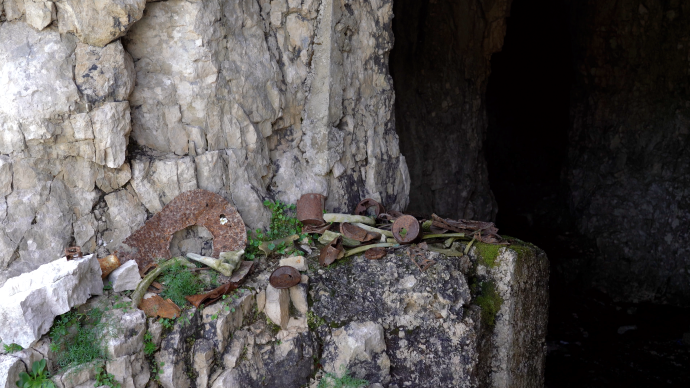
The RURALEX team held a small workshop on deep mapping with Paolo Gruppuso (RCC) and Anna Barcz (Polish Academy of Science)
The RURALEX team organised an online get-together with two guests, to talk about one of the project’s key methodological approaches: deep mapping. To do so we were joined by Paolo Gruppuso, an anthropologist based at the Rachel Carson Center for Environment and Society, LMU Munich; and Anna Barcz, an ecocriticist based at the Polish Academy of Science in Warsaw.
In the course of the meeting Paolo shared some of his work with maps in the Pontine Marshes, and his experience with (deep) maps in other contexts. Paolo described some of the workshops he led on deep mapping across various institutions (including a doctoral school at UiO), and as part of his teaching experience.
Anna provided an overview of deep mapping across both theory and practice, and offered an overview of her work on the Oder river, the Vitsula river, and on her current project on what she calls “monstrous river infrastructure” across the Rhine, Danube and Thames basins.
The meeting was an important moment of reflection for the RURALEX team, one that was generative of insightful conversations and will provide signficant insight for future research and project design.
Keynote on Abandonment and Environmental Change in the Alps
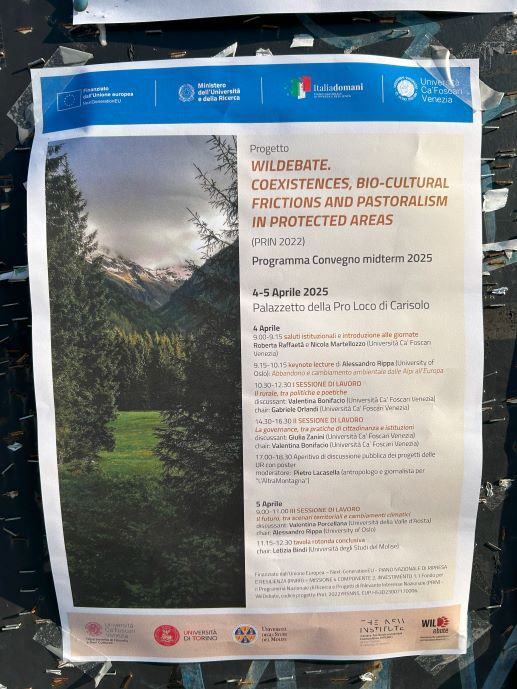
On April 4-5 Alessandro participated in the workshop “WilDebate – Coexistences, Bio-cultural Frictions and Pastoralism in Protected Areas”
The workshop was part of the project WilDebate, funded by a PRIN grant from the Italian Minister of University and Research including the University of Molise, the University "Cà Foscari" of Venice, and the University of Turin. The workshop took part in Carisolo, in Italy’s Trentino Province, and was organised by the anthropologists Roberta Raffaetà, Nicola Martellozzo, and Gabriele Orlandi.
As part of the workshop Alessandro gave a keynote talk titled “Abbandono e cambiamento ambientale dalle Alpi all'Europa [Abandonment and Environmental Change from the Alps to Europe],” in which he shared some of his previous work on hunting and land abandonment in Trentino. Alessandro focused in particularly on the history of the Alps as a global history, stressing the need to conjoin a political and multispecies perspective to address livelihoods and challenges of rural communities today.
The workshop was also a chance for Alessandro to discuss the scope and aims of the RURALEX project, and to learn from the various participants about ongoing research on relevant themes across different rural fieldsites in Italy. The workshop also included a moment of discussion and exchange with local stakeholders, such as employees of the Adamello Brenta Nature Park -- the largest natural park in Trentino and part of the largest protected area in the Alps.