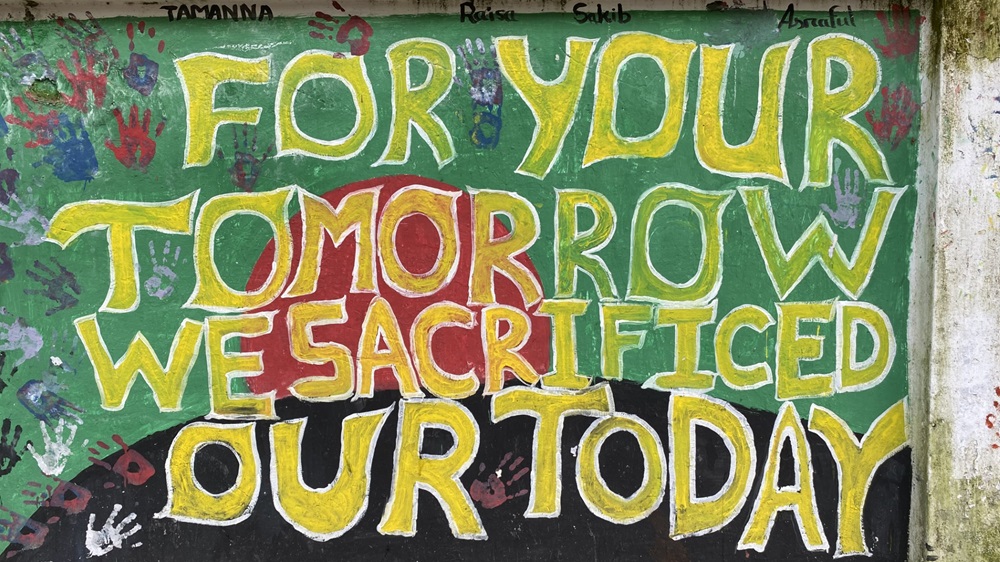
Eight months since the great uprising that saw the Hasina regime fall, it is now a little clearer what the future holds in store for Bangladesh. Leaders of the student-led movement that mobilised against the autocratic government have formed a new political party, launched only a few weeks back. A survey conducted on party preferences for the election that is expected later this year, put an immediate damper on the enthusiasm behind the new party: the survey suggested they can expect in the vicinity of five percent of the vote.
An election survey
There is reason not to put too much emphasis on what people tell in a survey. At the same time, it is clear that to Bangladeshi voters there is a clear distinction between movement and election. Many and possibly most people hailed the fall of the Hasina regime and were happy to see her out of the political scene; but running a country and doing a job for your constituency is quite another job. Voters are likely to be pragmatic when it comes to the ideological orientation of the candidates and to prefer candidates with the right skill set. What most voters want to see in a candidate is experience from the dirty world of politics, a broad and influential network, and proven ability to get things done. These are skills likely to be more attractive to voters than youthful enthusiasm.
An unsurprising finding in the survey was the 35-36 percent support for Bangladesh Nationalist Party (BNP), traditionally the country’s largest party after the discredited Awami League. BNP is a pragmatic, middle-of-the-road and broad party that has historically embraced all forces that wanted to be part of it – from leftist to rightists and anyone non-Awami League. With partnerships with a few minor parties, an election will give BNP a majority in parliament and the country a likely BNP-led government.
Are the Islamists coming?
The big surprise was the huge support for Jamaat-e-Islami, endorsed by close to one in three. On the wrong side of history in 1971, Jamaat has by many been seen as antinational and even after the ban on it was lifted, its best ever electoral result was around 10 percent (1991). But it does represent something BNP or indeed most other parties lack, namely a reputation for incorruptibility, dedication and philanthropy. In a survey we once conducted, it was clear that many saw Jamaat as the best hope for Bangladesh and the organisation that could fulfil the ambition to become a new Malaysia or Türkiye. However, the percentage of support for Jamaat in the survey needs to be considered in the broader spectrum where expression of public support for Awami League is now frowned upon. Therefore there are chances that Jamaat support may very well be less than what the survey was able to capture.
The survey has revealed new political divisions that have been visible for some time. BNP and Jamaat are the new rivals for people’s votes, a nationalist pragmatist party of unclear ideological orientation although basically quite centrist and secular vs. an Islamist and dedicated cadre-based party with a strong ideological orientation. For the moment, Jamaat is the weaker also organisationally and seeks to postpone the election until it has a stronger presence in more constituencies. BNP is the stronger for the moment and has an upbeat organisation ready to jump, and it wants an election as soon as possible – partly fearing Jamaat’s increasing popularity.
Interestingly, Awami League is predicted to receive some 12 percent of the vote. Many Awami League leaders and activists have flocked to Jamaat, but it is not self-evident that voters will follow.
A democratic Bangladesh?
What does this mean for the future of democracy in Bangladesh? And for the ability of the country to establish a democratic system that will endure beyond the first one or two elections? In order to ascertain this, we need to acknowledge two fundamental shifts over the last decade in both BNP and Jamaat. BNP has become consciously centrist and moved away from its rent-seeking past, largely under the firm leadership of its exiled leader Tarique Rahman (in London since 2007). Whether this shift is credible or a mere façade remains to be seen. The other is a generational shift in Jamaat, still ongoing, in which the thoroughly discredited 1971 generation of leaders is being replaced by a younger generation with a different outlook – and reputation. They are happy to see Bangladesh as an independent country, do not hanker back to a joint Pakistani state, and seek instead to economically develop the country while also creating a country in line with their notions of modern Islamic governance.
New party landscape
First, it is quite possible that the new division will be conceived of as more ideological and in some ways more real than the old one, between BNP and Awami League – two parties that in many ways were quite similar. BNP with its nationalist and anti-Indian background is more than likely to welcome overtures from China. India’s peculiar anti-Yunus attitude pushes in the same direction. What characterises China’s attitude to international collaboration is non-interference provided it gains access to central resources – in the Bangladesh case, harbours, gas resources, investment opportunities, and infrastructure contracts. China is already Bangladesh’ largest supplier of arms and a major creditor. At the same time, BNP is a pro-Western party that will use the China card to keep India at bay while welcoming investments from Europe and the US.
Jamaat on the other hand is likely to want to push the country in the direction of the Middle East, and to seek and receive patronage from religious organisations and others. If not in power, Jamaat will require funds to build its organisation and reputation, inter alia mosques, madrasas, and its many and popular philanthropic activities. However, its profile does not necessarily make Jamaat a friend of Middle Eastern autocrats weary of Islamists. The party however could continue to expand broader alliance with the Islamist movements and Muslim political lobbies at the West.
Sustainable democracy?
Secondly, none of these two parties are dedicated democrats. One assumption is that BNP in power will try to do what it can to stay in power. It now pledges commitment to new rules formulated now ahead of an election, but its adherence to such rules after it gains power is an open question. BNP did in the past try to manipulate election procedures, for instance by moving the retirement age of supreme court judges to have a sympathetic election time caretaker ministry. Besides, some of the leaders who were active then are still prominent in the party.
However, the constituents of the party have now changed. Young voters are now better informed about the world than previously. No-one under 35 have been able to vote in a free election and the desire to do so is widespread. If BNP tries to manipulate future elections, it is likely to face stiff resistance from both youth and others as the memories of the July 2025 resistance are still fresh. The rage against Hasina was the culmination of years of built-up frustration against corruption, arrogance, state violence, and the absence of free and fair elections. Bangladesh today witnesses a new awareness of the dangers of autocracy and a strong desire to have constitutional guarantees that ensure regular change of government. Political parties of the opposition, civil society, and perhaps most of all the pragmatic voter who may accept some, but not excessive corruption will likely object to any autocratic tendencies in the future. Therein lies great hope.
Arild Engelsen Ruud and Mubashar Hasan are at the Department of Culture, Religion, Asian and Middle Eastern Studies at the University of Oslo