
Between May 16-23 Leni and Alessandro travelled to Catania, in Eastern Sicily. They were joined by two Lebanese scholars: Dany Azar and Sibelle Maksoud, with whom Leni had previously worked in Lebanon, her main fieldsite. Dany is a paleontologist and entomologist working at the Nanjing Institute of Geology and Palaeontology in China, and he also holds a professorshipat the Lebanese University. Dany's research focuses on amber inclusions, particularly fossil insects from Lebanon. However, his expertise extends to ambers from all over the world and he is a recognised authority on amber-based research. Sibelle is a geologist and micropaleonogologist who has also extensive research experience with Lebanese amber as her work focuses on dating techniques through biostratigraphy and the use and identification of microfossils. She is a professor at the Lebanese University.
Simetite, the name given to Sicilian amber, has been known, used, and traded for millennia. It is generally found on the island's beaches -- in the east and the south in particular -- and traditionally most of it was collected in proximity to the estuary of the Simeto river. Yet pieces of amber have also been found in the inner parts of the island, leading to the widespread conviction that its deposit lies around the source of some of Sicily's main rivers. In turn, during phases of flooding those rivers are responsiblefor driving the amber stones to the sea.
The original deposit, however, has never been found. This has led to much speculation on the part of specialists and amateur enthusiasts alike. Moreover, the mystery of the amber deposit has prevented scholars from fully comprehending the exact age of Sicilian amber.

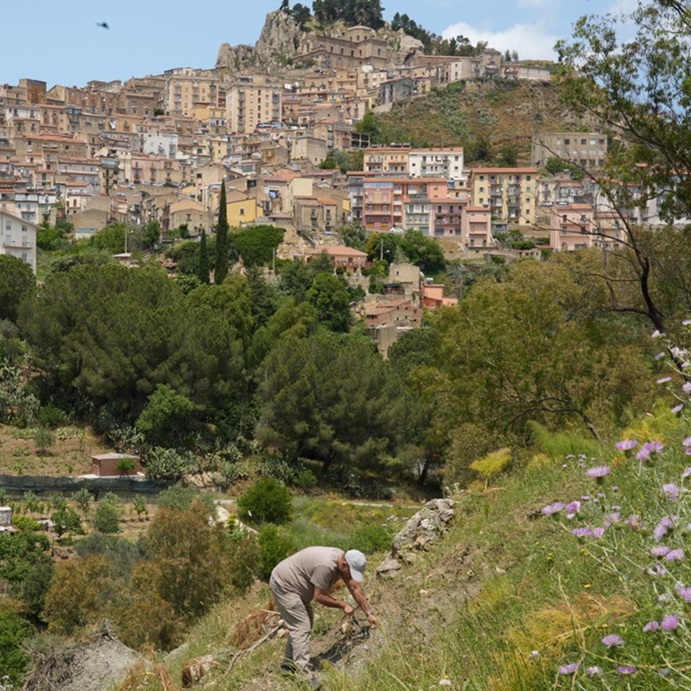
In an attempt to approach the puzzle of Simetite, our small team met with several local experts: geologists, amateur paleontologists, collectors, jewellers, and others who hold precious knowledge about amber, Sicilian history, and the island's deep past. We travelled to several possible outcrops across the Nebrodi and Madonie mountains, consulted geological maps, cross-checked historical sources and available paleontological evidence. We took samples that will be examined for pollen (critical for relative dating), and gained a better sense of what the conditions that led to the formation of Sicilian amber might have been.

With the help of the local Department of Biological, Geological, and Enviornmental Science, and in particular of Dr. Maria Cristina Caggiani, we also held a small conference on amber at the University of Catania. This was an occasion for Leni and Alessandro to present the AMBER project, for Dany and Sibelle to discuss their research in Lebanon, and for a local jeweller, Ugo Longobardo, to show the history and beauty of simetite.
We did not find the deposit, though we were able to uncover possible geological associations and indicators of environmental conditions that could have produced amber. On this research trip, amber proved to be an insightful lens through which we could learn much about Sicily’s history and with which we have been able to make important connections for future research.
