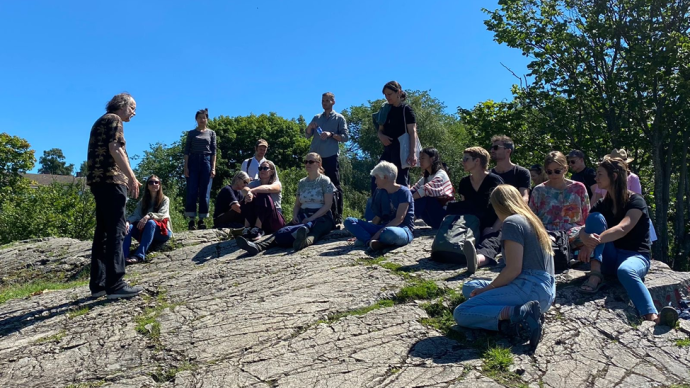
Those convened over the course of the three-day workshop – co-organized by Alessandro Rippa and Zeynep Oguz – were representatives of an increasing attunement to the geological across social life and its study. Invited participants included not only anthropologists, but also historians and geographers, and panel discussions were enriched by the presence of UiO scholars sharing perspectives from the fields of STS, philosophy, and sociology.
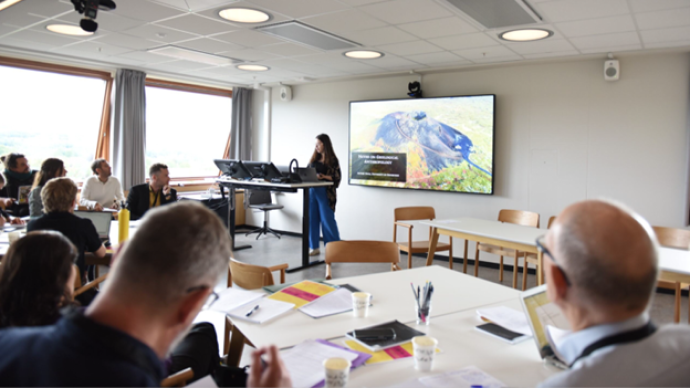
The lines of conversation and deliberation emergent throughout the workshop orbited a dual-nature of “the geological”: in one respect, the questions and challenges of the Anthropocene necessitate intentional inclusion of earthly processes into the ways in which social worlds are lived, analyzed, and re-imagined; on the other hand, as several participants highlighted, formalized knowledge about earth systems and history – whether within the disciplines of Geology, Geophysics, Paleontology, or related fields – are nested within legacies of imperialism and extractivist regimes.
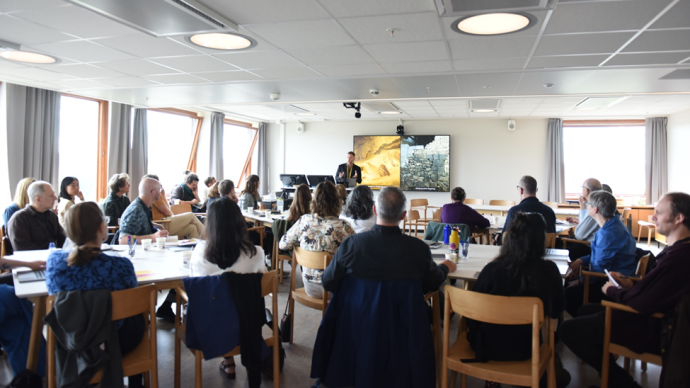
And yet, when one digs beneath the surface of these legacies – as much of the scholarship of the workshop participants has done – formalized Geological knowledge is found to sit upon the contributions of diverse traditions and analytical systems, as well as fragments of esoterica, political squabbles, hidden geographies, subterranean tactics, sublime intrigue, intimacy, and fright, and many other modes of reckoning with the underground. A central and productive question emerged from the different veins unearthed throughout the workshop: is the objective of a geological anthropology to position the formal earth systems disciplines as the subject of an anthropological gaze – to humanize the messy production of the Geological – or is it rather to attend to and partake in the production of alter-geologies, alternative modes of sensing and living with complex earth systems – to conceive of new ways of geolizing the anthropos?

This question and its possible answers, perhaps, are the central challenges provoked by the very concept of a geological anthropology, and indeed by the June workshop itself. Workshop conveners Zeynep Oguz and Alessandro Rippa organized the event to hold these analytical and speculative threads of “the geological” together. Panel discussions were carried forth to accommodate Geology’s layered complexities through the following themes: Stratifying, (Un)Grounding, Knowing, Living, and Timefullness. The workshop was furthermore designed to facilitate two experimental sessions, during which participants were given the task to collaborate towards protocols to assess topics raised during the panel discussions. The dialogs formed through these experimental exercises will form the bedrock for the eventual publication of the workshop proceedings.
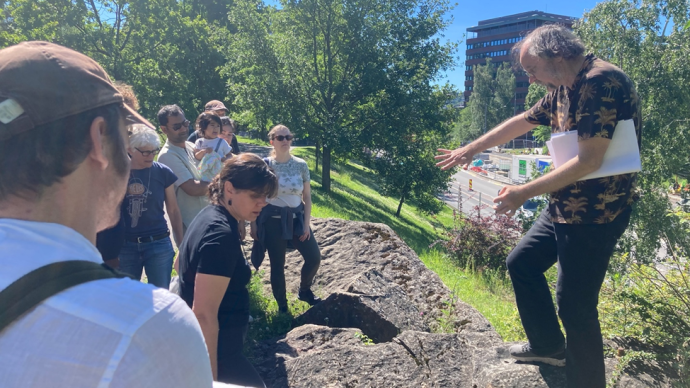
Following a full workshop program at UiO (campus Blindern), participants were invited to turn their geological sensibilities towards the wider (and deeper) Oslo area through a guided geological walk by Professor Øyvind Hammer. With his storied sense of deep time and charismatic opinions on Oslofjord’s most interesting (and boring) rock formations, Professor Hammer directed the workshop cohort to more and less conspicuous geological features within the urban landscape to showcase the predominant geologic processes of the region. Our group was invited to find new orientations alongside glacial patterns, feel the crumbling verticality of ancient, uplifted seabeds, and to consider how Oslo’s social demographics and histories are conversant with its geological footprint. The outing concluded at the Natural History Museum, where Professor Hammer guided us not only through its artefactual collections, but also the personalities, personal histories, and politics behind the production of geological narratives showcased there.