Diverse Burmese amber worlds in Munich


In the end of April, 2025, Laur visited the city of Munich (München) in Germany—to explore the surprisingly diverse Burmese amber worlds there.

Bildet kan inneholde: smykker, oransje, edelsten, kroppsmykker, halskjede.

Amber jewellery and objects from the Burma–India borderlands. Collected in the early 1910s by Lucian and Christine Scherman. © Museum Fünf Kontinente, Nicolai Kästner.

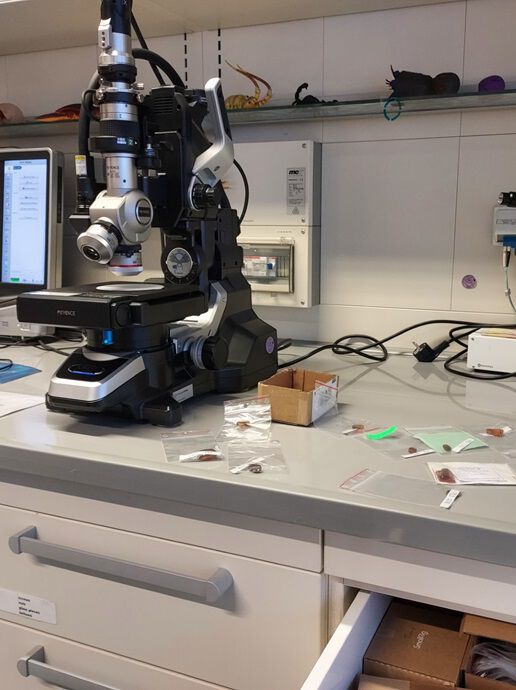
First, Laur visited the palaeontology lab of professors Carolin and Joachim T. Haug (the ‘Palaeo-Evo-Devo’ lab), where several researchers have been studying and publishing on the exceptional fossils inside Kachin and other ambers. The lab’s members introduced their everyday work, goals, and challenges. They explained how Kachin amber has opened up both new knowledge and controversy—about evolution and extinction, dinosaurs and larvae, and politics and ethics.
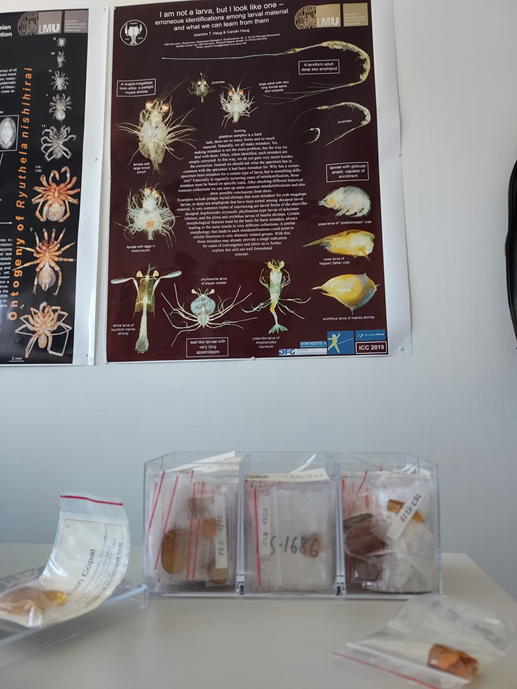
Plakat inne i et laboratorium.
From amber to research: A scene in the lab. Photo: Laur Kiik
Mikroskop
From amber to research: A scene in the lab. Photo: Laur Kiik


Second, Laur visited the Five Continents Museum (Museum Fünf Kontinente), which hosts more-than-a-century-old amber jewellery from the Burma–India borderlands. The museum curator Dr. Anne Hartig introduced the collection and its history. The makings and travels of this jewellery show how connected are the local Kachin, Tai (Shan), Naga, and other peoples. The Museum also holds many rare photos of Kachin and other peoples and lands in Burma and India in the early 1910s.

To Kachin jenter
Photo from the early 1910s in the upper Chindwin river area. The person on the right is wearing amber ear-plugs that are now displayed in the museum. Many such photos are held and digitized at the Five Continents Museum in Munich, Germany. © Museum Fünf Kontinente, Sammlung Fotografie.


Published June 23, 2025 1:34 PM - Last modified June 4, 2026 11:09 AM