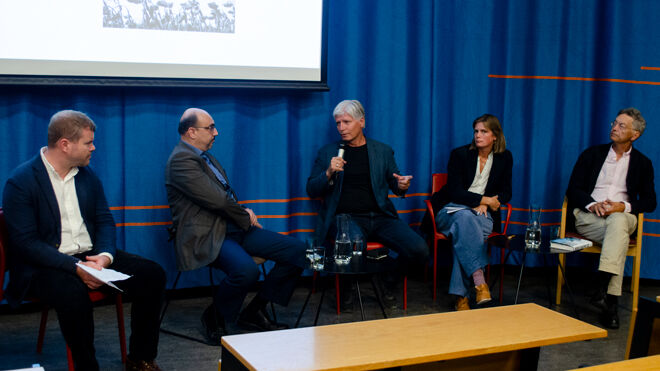
This text has been translated from Norwegian with the assistance of GPT UiO.
– I think it went very well. It was an interesting lecture by Eugene Finkel. It was fascinating to hear about the historical backdrop to Russia's violence against Ukraine, says Tore Wig.
He has recently taken over the leadership of the master's programme in Peace and Conflict Studies (PECOS), of which the annual PECOS lecture is a part.
Topical issue
– I believe it is particularly important to understand this history when discussing today's situation, where one talks about peace negotiations — which direction the war is taking — this historical backdrop is also relevant, he elaborates.
Eugene Finkel, born in Ukraine and now Kenneth H. Keller Professor at Johns Hopkins University, is a leading expert on mass violence between states and within states, according to Wig.
Finkel's principal argument during the PECOS lecture was that violence and oppression are deeply rooted in the history of Russians and Ukrainians, and that the main cause of Russia's aggression is driven by two factors: identity and security, with regime security being the most crucial.
Useful research
– The topic is relevant for those who wish to understand different types of armed conflicts and political violence. In that sense, he is relevant academically, Wig continues.
He points out that Finkel presented new research on the conflict between Russia and Ukraine, which currently ranks high on the political agenda.
– I think that the PECOS programme should be focused on robust social science research, but also current issues. And I believe Finkel does this well.
– This is a prime example of how research and academia can be used to understand the challenges we face in today's international world, concludes Wig.