Webpages tagged with «education»

In this article Arno Van Hootegem, Ole Røgeberg, Bernt Bratsberg and Torkild Hovde Lyngstad examines the correlation between cognitive ability and educational attainment across male birth cohorts in Norway. Their findings can be read below.

In this article, Torkild Hovde Lyngstad and co-authors investigate interactions between polygenic indices for educational attainment and environmental levels. Their findings can be read below.

In this working paper, Tina Baier and co-authors examine the role of genes in the study of equality of opportunity. They do this by testing theoretical assumptions, using twin methods and register data from Finland. Their findings can be read below.

In this article, Are Skeie Hermansen and co-author visualize women's and men's college majors across four decades in Norway. This visualization underscores the progress that has been made in achieving gender parity in education as well as the challenges that remain.

In this article, Are Skeie Hermansen uses administrative data from Norway to show that exposure to better-educated immigrant neighbours from the same origin country is related to lower risks of criminal engagement and higher likelihoods of completing upper-secondary education. Overall the findings support the predictions of assimilation theories which emphasize that access to social capital and socioeconomic resources within local ethnic enclaves shape the future life chances of immigrant youth.


In this working paper, Tina Baier, Torkild Lyngstad and co-authors investigate whether intergenerational transmission reflects within-family processes or social inheritance. Their findings suggest that the effects of the environmental processes characterized as “nurture” are explained less by parents’ specific behaviors and more by dynastic stratification in environments relevant to success in school.

In this article, Martin Isungset, Torkild Lyngstad and co-authors investigate if birth order differences in education are caused by genetic differences. Their findings show that birth order differences are not biological in origin, but pinning down their specific causes remains elusive.

In this article, Tina Baier, Torkild Lyngstad and co-authors address a shortcoming in previous research on intergenerational correlation of educational attainment, by adopting a Multiple-Children-of-Twin design and decompose the ICE into its environmental and genetic transmission mechanisms.
In this working paper, Tina Baier focus on the extent to which parental separation affects genetic influences on educational attainment across 20th Century birth cohorts.
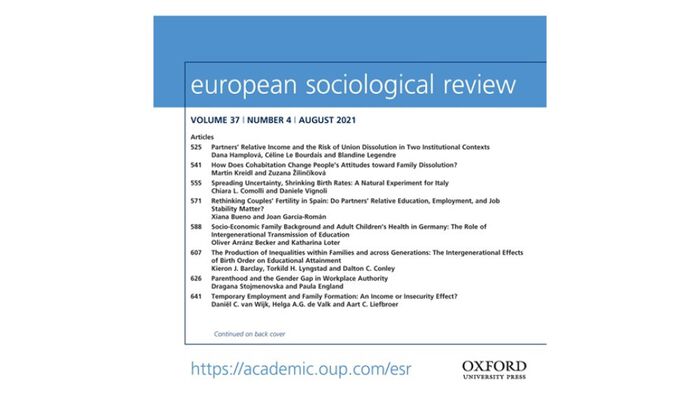
In this journal article, published in European Sociological Review, Torkild Lyngstad and co-authors ask whether birth order in the parental generation influences the educational attainment of their children.
In this research article, publised in Demography, Torkild Lyngstad and co-authors study sibling similarity in cognitive skills, school grades, and educational attainment in Finland, Germany, Norway, Sweden, the United Kingdom, and the United States.
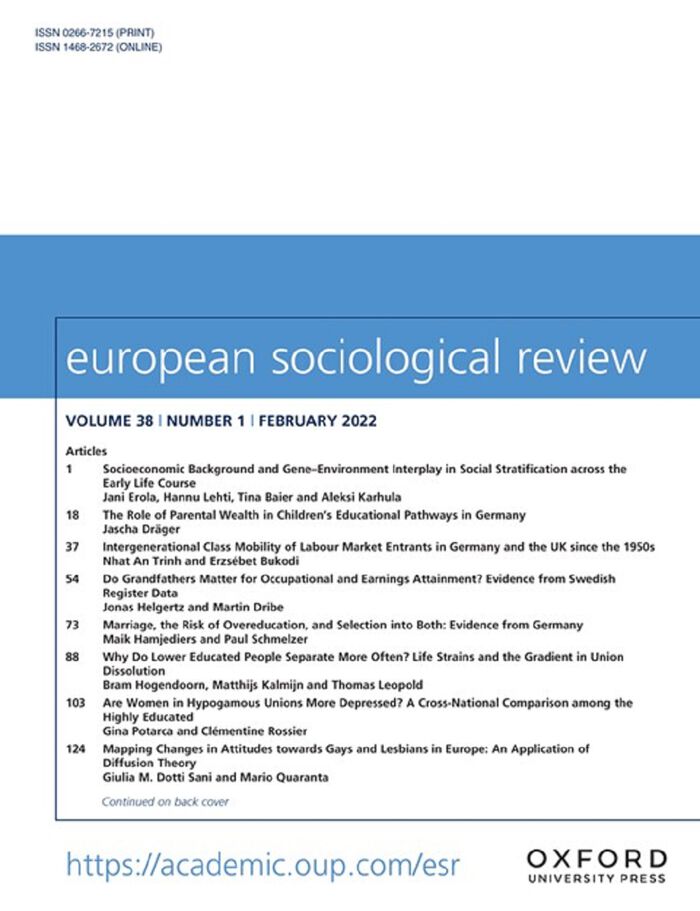
In this article published in European Sociological Review, Tina Baier and co-authors ask to what extent differences in education, occupational standing, and income are attributable to genes, and do genetic influences differ by parents’ socioeconomic standing? When in a children’s life course does parents’ socioeconomic standing matter for genetic influences, and for which of the outcomes, fixed at the different stages of the attainment process, do they matter most?
