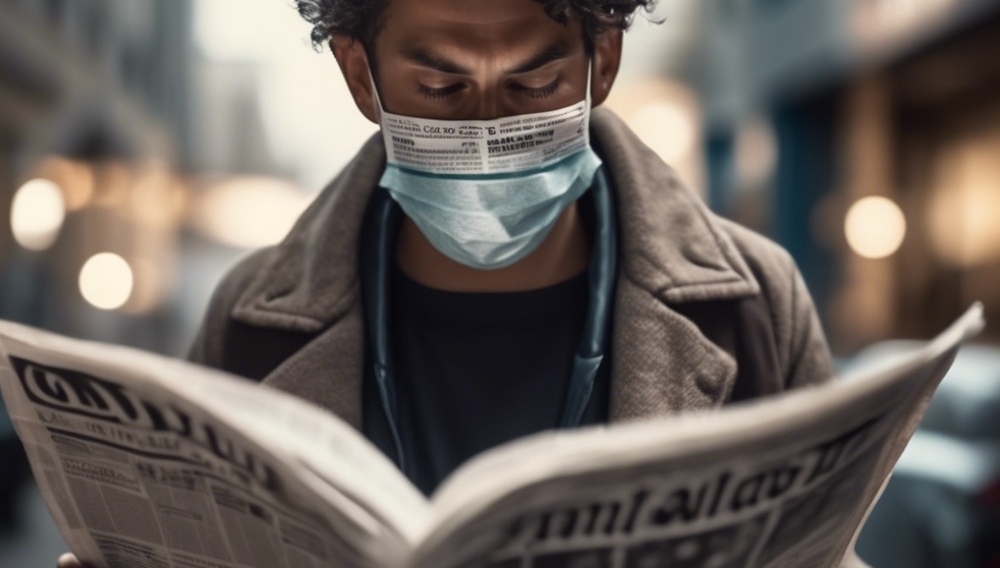
In an article published in Media, Culture and Society, we explore the role of the media in the phenomenon of contemporary racism, defined as the practice of systemic (institutionalized) discrimination based on an assumption of racial or ethnic superiority of a group over another. More specifically, we outline the discursive mechanisms through which insidious, hidden forms of racism can exist “invisible in plain sight,” even in the mainstream media and public discourse of countries, like Norway, that regard themselves as democratic and tolerant.
This argument squarely challenges the common-sense and widespread narratives about Norway. It is simply difficult to believe that racism can exist in Norway—let alone that it is a feature of its everyday news—when the country regularly tops the rankings of the Democracy Index, and is considered the happiest places in the world to live in. Yet, this is precisely the challenge we embark on in exposing the nature of “new racism.”
Although the concept of race is discredited and blatant racism has been on the wane for decades, racism still exists in covert forms. New racism gains its strength precisely from the fact that it does not appear to be racism. The media, who notoriously create the reality we live in - one story at a time - and construct the standards of what we regard as normal, plays a key role in this process of camouflaging.
Racist discourse in Norway is not an extreme manifestation of far-right ideology that takes place at the edge of society, expressed for instance through slurs by radical individuals. It is rather a feature of the mainstream: produced and reproduced, against all expectations, by journalists and ordinary citizens who would not regard themselves as racist, who are largely unaware of their unconscious biases and the far-reaching consequences of the language they use. This kind of racist discourse does not depend on the use of denigratory or openly offensive terms. To the contrary, it blends so seamlessly under the guise of apparently neutral language that it becomes almost impossible to detect.
Unveiling racism in everyday news: Why it matters
Our findings result from a critical discourse analysis of how three national newspapers (Aftenposten, VG, Klassekampen) portrayed immigrants during the pandemic. The analysis reveals the presence of already existing and widely shared racist scripts. Although they became more noticeable during the Covid-19 crisis, they in fact underlie public- and media discourse at all times. During the pandemic, newspapers tended to juxtapose a “pure” and “healthy” inside of the country (norsk), to an “infectious” and threatening outside (ikke-norsk). We found evidence of stigmatization of specific ethnic groups, particularly Pakistani, Somali and Polish. The systematic discrimination in the coverage was at points expressed explicitly, through terms that, for instance, openly associated Covid-19 infection with immigrants, like innvandrersmitte [immigrant infection]. Racist discourse, however, operated most often subtly, in the assumptions behind a text and through details that might look harmless or even irrelevant. Examples of these trends are stories about “the good immigrant”: an individual with immigrant background who is portrayed as following anti-Covid rules in an exemplary manner, thereby implicitly underlining that the rest of his/her community is not complying with them. One instance of a seemingly “irrelevant detail” is the mention that “[a]lmost every second person who has tested positive in Norway was born abroad or was born in Norway to a foreign mother” (“Nearly half of the infection has happened in an immigrant environment,” Aftenposten 04.02.2021, emphasis added). This reference, again implicitly, explains the status of immigrants during the pandemic in essentialist and simplistic terms, as a direct outcome of culture or even biology.
Although many studies in Norway find evidence of ethnicity- (or perceived-ethnicity) based discrimination against immigrants and their descendants in a wide range of arenas such as the workplace, housing market, school- and healthcare system, there is a strong reluctance to acknowledge this as racism. The situation echoes the denial of racism that occurs in democratic countries like the US, the UK, or Australia. Based on our findings, we establish not only that racism does exist, but that it does so under the guise of “normality” and what is taken for granted, which helps explain why it continues to exist, practically undisturbed. Furthermore, we point to the key role of mainstream media, not just alternative and radical outlets, in the normalization of racism.
Where do we go from here?
Racism in Norway exists as discriminatory practice, but it is also enabled by- and operates through assumptions underlying media stories: it is present in the way information is formulated and framed in news reports, and it hides under the surface of what looks or sounds natural to the public. While we examined the covert manifestations of racism within the timeframe of the pandemic, the features of coverage and the Othering of immigrants we identified are common and indeed ordinary for media discourse in the country.
The results of the study raise a range of urgent questions, both methodological and practical: How to detect racism and discrimination that is hidden “between the lines”, where it can remain practically unchallenged? How to educate journalists to be more mindful of diversity, when racism is built into one’s assumptions about the world? How to expect trust in the media, or authorities, or integration, when a racist worldview is the backdrop to one’s life?
Our analysis shows the way in which a very selective – certainly not objective – presentation of information has led to a narrow range of arguments within the coverage- and racist representation of immigrants. Media discourse mostly blamed “non-Norwegians” for spreading the infection. By contrast, the findings encourage thinking about what alternative narratives and lines of enquiry journalists could have pursued to function as a unifying force for public discourse at a time of global and national uncertainty and turmoil. For instance, why are some groups more vulnerable than others? How and why are they being let down by the rest of society? How is it possible that some communities, in a society supposedly characterized by equality, are suffering more than others?