
As we step into the first days of 2025, one defining feature of the year we leave behind stands out. 2024 became the year when the relationship between “traditional” gender values, anti-feminism and far-right ideology crystalised in mainstream politics and political debate: it marked a turning point where the misogyny at the core of this marriage moved from subtext to text – from the margins of conservative thinking or the extreme end of a political movement to take centre stage. This was on full display during the U.S. election campaign where it became clear that ideas of female subservience and a political project to subjugate women's bodies to patriarchal control, were at the very core of the base on which Trump ran and won.
Mainstreamed and Institutionalised Misogyny
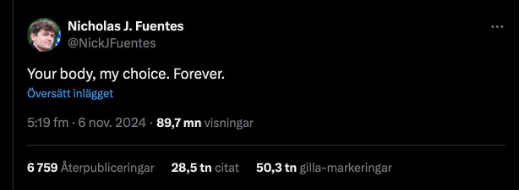
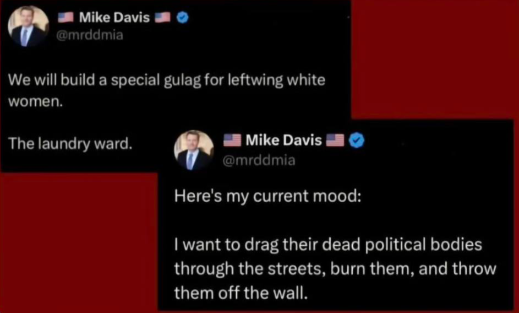
Technology has provided powerful new platforms for expressing and spreading ideas of female submission and inferiority – ideas that fuel the digital spaces of for example incels, the manosphere or the so called tradwife movement, all of which are emblematic of how antifeminism and anti-women agendas function not as stand-alone ideological currents but as galvanising forces within a broader, global far-right movement. And, while misogyny has always been an integral part of far-right ideology, developments in 2024 marked a shift, bringing misogyny even more into the open and elevating it to new levels of discursive violence. The days immediately following Trump’s re-election, the onslaught of misogynistic threats and slurs online made by the squad of male pundits, podcasters and masculinity influencers driving the pro-Trump/Vance campaign on social media, no longer felt the need to moderate their misogyny in any kind of ambiguity (e.g. photo 1). The posts below, circulated in the prelude to- and in the days after Trump’s re-election, are not comments made by anonymous users in an obscure online discussion forum or an encrypted message service. Rather, these statements were posted by one of the most powerful conservative influencers in the MAGA coalition and former Supreme Court clerk who, at the time, was in the running to be the next Attorney General in the U.S (photo 2).
Further evidence that the alliance of male supremacist and misogynist ideas has evolved into a viable political project and key focus in mainstream institutional politics can be found in the 2025 Presidential Transition Project (Project 2025): a federal policy agenda drafted by the conservative think tank The Heritage Foundation, which is backed by a wide range of conservative organisations. This 900-page document outlines detailed plans for enacting a radical restructuring of the US government and society along conservative lines under the future Republican administration. At the core of the blueprint are concrete plans to (further) roll back rights and protections related to gender equity, including legal frameworks that promote gender equality in workplaces, reproductive autonomy and LGBTQ+ rights.
Contemporary U.S. politics may be the most recent and obvious example of a country where dynamics of democratic backsliding and gender backlash are unfolding. However, we have also seen a multitude of political forces across the world that mobilise around gender with the confluence of anti-feminism, misogyny, male supremacism and far-right ideologies emerging as a political phenomenon in its own right. Social media is at the core of this development, amplifying the dissemination of misogynistic and sexist attitudes on a global scale, fostering transnational synergies and a common grammar of misogynist extremist language that work across seemingly distinct political contexts from the U.S. to Iran.
Implications for Extremism Research
For a number of years now, studies of violent extremism have been heavily preoccupied with far-right extremism in a fairly monolithic way. And for good reason. This has been an important corrective to decades of media, state and scholarly attention and research funding going to questions of the so-called jihadi threat and Islamist extremism – not least in the literature on means to counter violent extremism. With that said, recent years’ re-orientation to the focus on far-right ideology and homegrown threats to democracy may also have had certain blind spots towards gender and misogyny and to the ways in which racism and white supremacy invoke gender in important ways.
When gender is applied as a lens in the field of extremism research, there has been a tendency to treat gender as synonymous with women, and women's themselves are largely discussed in terms of role types. When women are made the key focus of research, we tend to treat them as daughters, wives or victims – an observation made already in the early 1990s by Kathleen Blee in her seminal work on the women of the Ku Klux Klan. Here, Blee argued that women's participation was often overlooked or diminished to mere supporting roles, despite their significant contributions to the movement. Historian Claudia Koonz, in her work on women in Nazi Germany, highlighted similar trends noting how women were integral to the advancement of Nazi ideology but have later, when history is written, only been recognised in domestic or supportive capacities. The pioneering work of Blee and Koonz should remind us to recognize women's active participation and leadership in extremist groups today, to acknowledge that women too align with heteropatriarchy and internalise and perpetuate misogyny and ideas of female subordination. This makes female-fronted misogyny an important site of analysis, the contemporary expressions of which we are only just beginning to explore and pin down.
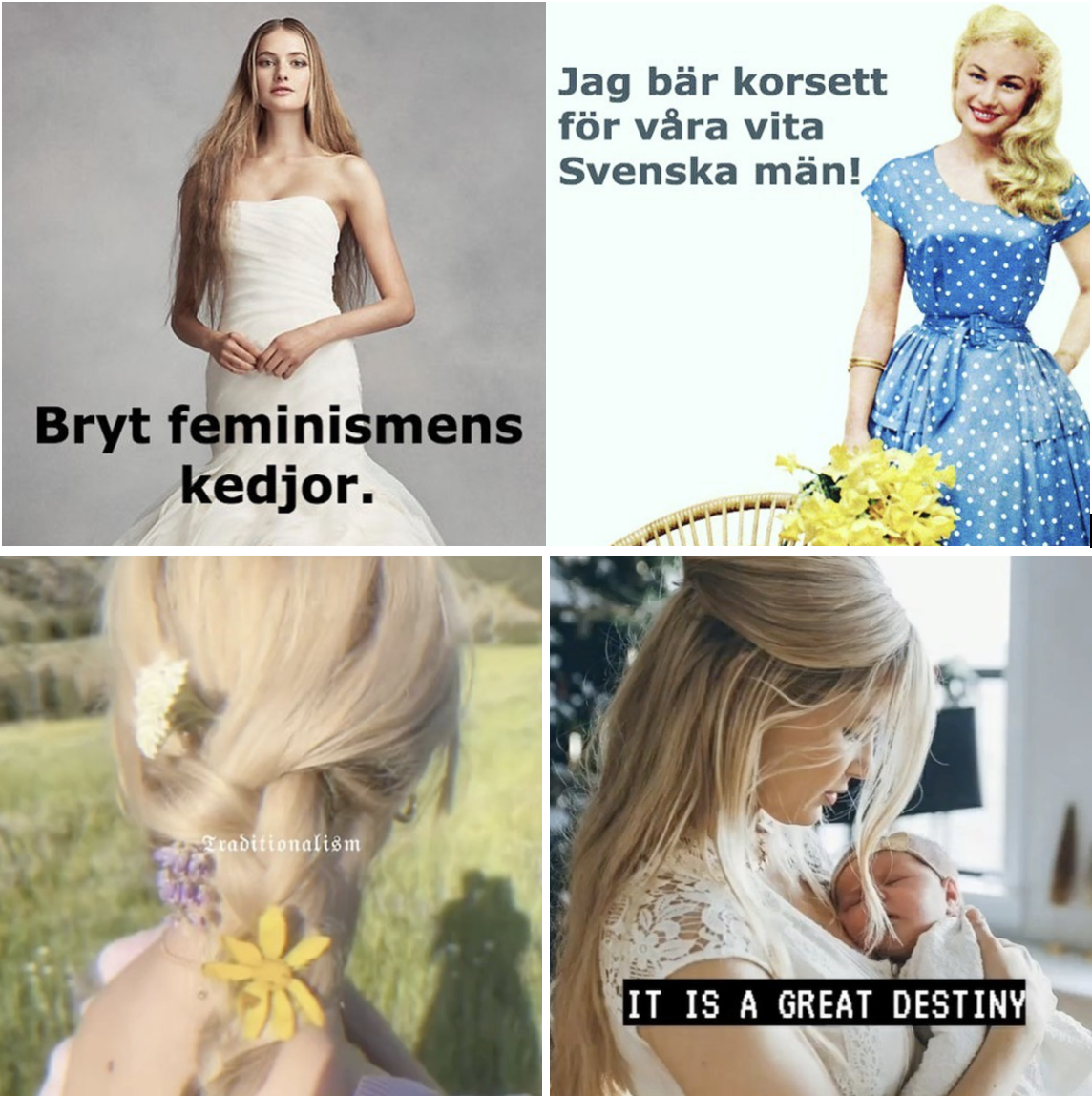
Top-right: I wear a corset for our white Swedish men!]. These photos circulate online, are used for different purposes, and can be traced back to multiple users/accounts.
More generally speaking, we need intersectional analytical frameworks that help us understand the ways in which gender is invoked across a range of contexts and projects from conservative politics to violent far-right extremism. We need flexible analytical approaches as proposed by Kathleen Blee and colleagues in a previous post here on RightNow! – whose ‘constellation model’ shuns labels (such as alt-right, radical right, far-right extremism) and strict categorisations between actors, groups and movements. Instead, the focus should be on the dynamic constellation of practices, ideas, and emotions that straddle diverse political fields and issues ranging from anti-abortion and anti-transgender activism to white supremacism and ecofascism. And finally, we need frameworks that helps us probe how misogyny and far-right ideology is propelled by digital technologies that connect spaces, actors and amplify networked misogyny, but which conversely also can hinder its spread.
The question, then, is whether the interdisciplinary research community focused on extremism, radicalization, and terrorism is rising to meet this challenge. There are some indications of a growing consensus among scholars that gender and misogyny are not just peripheral concerns, but central components of far-right ideology. This has prompted heightened academic interest in how intersecting political currents of misogyny and extremism increasingly shape public conversations and political struggles over gender equality, human rights and social justice. Calls have been made for a new research agenda where this receives due recognition, and for researchers to highlight how white supremacy, heteronormativity and cisnormativity work together to shape and sustain extremist ideologies, exclusion, and perpetuate violence. In the Nordic context, the biannual NCVE conference (Nordic Conference on Violent Extremism) rotating among Nordic countries serves as an important platform for advancing these discussions, and for bringing researchers and practitioners together. The program at the 2024 conference, hosted by the Centre for Research on Extremism (C-REX) in Oslo, reflected a shift in the scholarly agenda with more than a third of the program dedicated to questions around gender and extremism. The conference featured papers addressing a wide range of topics, including anti-gender movements across national contexts; the intersections of masculinity, territory, and race in extreme-right manifestos; the role of positive affect and remasculinization in ecofascist propaganda; sex, masculinities, and anti-feminist nostalgia in the manosphere; and militarised masculinities in far-right online spaces. Additional presentations explored themes such as gender and conspiracy theories, anti-gender dog-whistles, violent extremism and anti-trans politics, as well as incel subcultures, focusing on identity, victimhood, and the links between incel ideology, antisemitism, and far-right authoritarianism.
While this rich program reflects a promising trajectory for gender perspectives in extremism research in the Nordics and beyond, sustained and concerted efforts are needed. As the surge of anti-gender mobilisations and the global backlash against women’s rights continues to intensify, it becomes increasingly critical for the field of extremism to address how gender, or the phantasm of gender operate as a logic that legitimises violence. Contemporary developments require a sustained focus on the intersections of anti-feminism, misogyny and far-right extremism placing their convergence at the centre of scholarly inquiries, advocacy efforts, and policy-making.