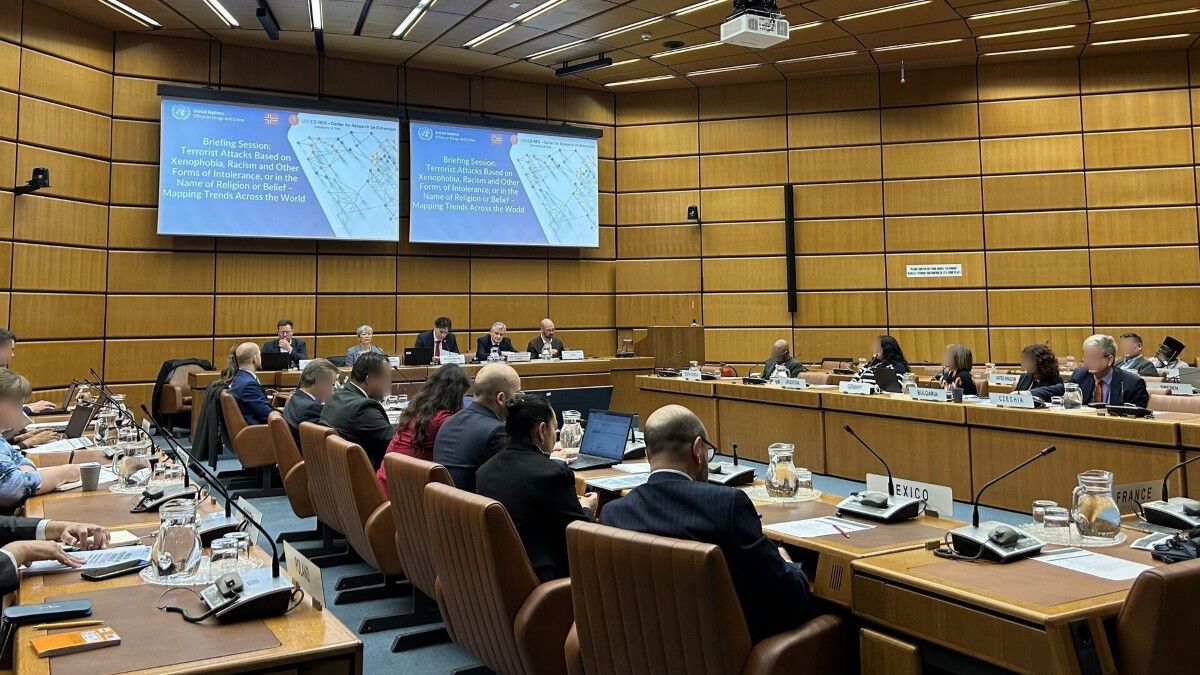
C-REX Director Anders Jupskås and the project leader for the RTV dataset, Associate Professor Jacob Ravndal, recently presented new research findings during a United Nations briefing session in Vienna.
The session, entitled "Terrorist Attacks Based on Xenophobia, Racism and Other Forms of Intolerance, or in the Name of Religion or Belief – Mapping Trends Across the World," was hosted by the United Nations Office on Drugs and Crime, with support from the governments of Norway and Germany.
In his presentation, Jacob Ravndal discussed measurement challenges in far-right terrorism research and examined trends in right-wing terrorism and violence in Western Europe. Anders Jupskås provided a comparison of trends in the Global North, along with programmatic implications.
The presentations featured findings from the upcoming RTV Trend Report, which is available here.
Further details on the session can be found on the United Nations website.
Key takeaways
A significant methodological takeaway from the presentations was the observation that existing datasets are not valid or reliable sources for threat assessments. However, higher-quality data collected by C-REX and their U.S. colleagues responsible for the ECDB dataset reveal somewhat unexpected trends in right-wing violence.
First, there is no substantial increase in right-wing violence and terrorism in the Western world, including regions like Western Europe, North America, Australia, and New Zealand. Second, fatal terrorist and violent attacks by the far-right are currently almost exclusively carried out by lone individuals. Third, the most common form of right-wing violence involves spontaneous acts by gangs and unorganized groups, rather than premeditated terrorist attacks by lone actors. Fourth, despite discussions about the transnational dimension of the far-right threat, the nature of far-right violence and terrorism remains heavily shaped by national, regional, and local contexts. Finally, most detected plots are unlikely to materialize, often due to unclear target selection or inadequate operational planning, or both.
These presentations were followed by three online discussions that covered trends in the Global South, including case studies from Argentina, Brazil, and South Africa.